




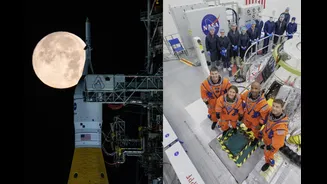
A Giant Leap Returns
After a hiatus of over fifty years since the conclusion of NASA's Apollo program in 1972, humanity is once again poised to journey towards the Moon. The
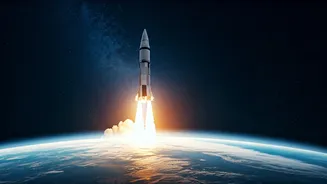
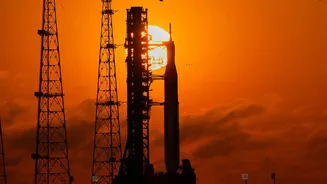
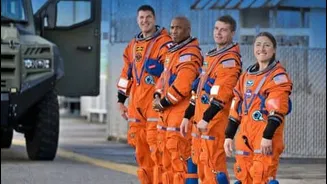
Artemis 2 mission, carrying four astronauts, is set to launch, signifying a momentous revival of crewed lunar expeditions. Following some technical setbacks earlier in the year, the mission is now gearing up for its ascent, with the launch anticipated for April 1st (or April 2nd in India). This mission, however, will not involve a landing; instead, the astronauts will execute a circumnavigation of the Moon. This orbital flight is expected to break at least two significant spaceflight records. Depending on the precise launch window and flight path, the crew could achieve a maximum distance exceeding 400,000 kilometers from Earth, marking the farthest humans have traveled since the Apollo 13 mission in 1970. Furthermore, their return journey could see them reach speeds of up to 40,000 kilometers per hour, surpassing the 1969 record set by Apollo 10 at 39,897 kmph.
Lunar Water's Impact
The resurgence of interest in crewed lunar missions, exemplified by the Artemis 2 launch, owes a significant debt to the discovery of water on the Moon, a finding notably spearheaded by India's Chandrayaan-1 mission. Previously, the prevailing scientific consensus, based on lunar rock samples from the Apollo missions, suggested a stark absence of water and geological activity on the Moon. This perceived barrenness made sustained human presence seem impractical, as any necessary resources for life support or propulsion would have to be launched from Earth, incurring immense costs and logistical challenges. G Madhavan Nair, the former chairman of the Indian Space Research Organisation (ISRO) who oversaw Chandrayaan-1, noted that after the Apollo landings, the Moon was viewed as an uninteresting, uninhabitable celestial body. This perspective significantly dampened enthusiasm for further exploration until the Chandrayaan-1 mission provided compelling evidence to the contrary, fundamentally altering the scientific and public perception of our closest celestial neighbor.
Chandrayaan's Discovery
The Chandrayaan-1 mission, conceived as a remote-sensing endeavor, carried a suite of both Indian and international scientific instruments. Crucially, it included NASA's Moon Mineralogy Mapper and ISRO's own spectrometer. The mission's design was not predicated on the certainty of finding water, but rather on existing scientific theories. S Somanath, who later served as ISRO chairman and oversaw Chandrayaan-3, explained that a NASA payload specifically designed to detect water signatures was included, alongside ISRO's spectrometer. The initial data returned was subtle, prompting a cautious scientific response. However, spectral analyses revealed the presence of hydroxyl and water molecules embedded within lunar minerals across vast surface areas, with a notable concentration towards the polar regions. This discovery was later confirmed and amplified when NASA published its findings, validating ISRO's own data. Madhavan Nair characterized this as a collective achievement, where the datasets from both nations corroborated the presence of water, reigniting scientific curiosity and the prospect of future lunar habitation and resource utilization.
Resource Potential Unlocked
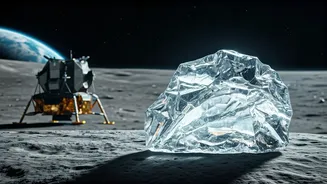
The implications of water discovery on the Moon extend far beyond mere scientific curiosity; it transforms the Moon into a potential staging post and resource hub for future space exploration. Madhavan Nair elaborated that further analysis of the Chandrayaan-1 data suggested that water could exist in the form of ice within permanently shadowed craters, particularly in the southern polar region, with estimates pointing to billions of tonnes. This finding was monumental because water is indispensable for various mission requirements. If water is readily available, it can be processed to produce hydrogen, a key component for rocket fuel, thereby significantly reducing the dependence on Earth-launched propellants. S Somanath highlighted that the identification of hydroxyl molecules, especially near the poles, made the prospect of finding trapped water or ice a tangible reality. In the Moon's vacuum environment, liquid water cannot persist on the surface; however, its presence beneath the polar regolith makes it a viable and accessible resource. Beyond water, Chandrayaan-1 also identified significant deposits of helium, including helium-3, an isotope highly regarded for its potential as a future fuel source for nuclear fusion reactors, further enhancing the Moon's strategic value.
Future Vision Ignited
The impact of the Chandrayaan-1 mission is widely recognized as a catalyst for renewed lunar endeavors, as articulated by M Annadurai, the project director for Chandrayaan-1. He firmly stated that "Things revived because of Chandrayaan-1. There is no doubt about that," emphasizing its frequent citation in international scientific forums. This mission fundamentally shifted the vision for lunar exploration from brief visits to extended stays, fostering international collaboration and envisioning possibilities like a lunar space station and missions venturing deeper into the solar system. Annadurai proposed that "The Moon becomes an outpost, a launch pad to Mars." Further solidifying this vision, ISRO's Chandrayaan-3 successfully landed near the Moon's south pole in 2023, transmitting invaluable data on regolith behavior, thermal characteristics, and seismic activity. S Somanath remarked that these direct surface-level observations, which complemented the remote sensing of earlier missions, demonstrated that the Moon was not a geologically dormant body, but rather a dynamic celestial object. This understanding, built upon decades of scientific inquiry and technological advancement, provided the critical justification for ambitious programs like Artemis.