


Revisiting Europa's Eruptions
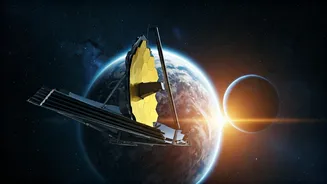
New scrutiny of data gathered over 14 years by the Hubble Space Telescope has led scientists to reconsider their previous assertions about water vapor
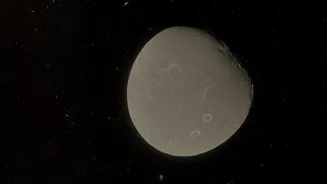
plumes erupting from Jupiter's moon Europa. Team members who in 2014 proposed the existence of these plumes now express significant uncertainty, with lead researcher Kurt Retherford of the Southwest Research Institute noting that the evidence isn't as robust as initially understood. This reassessment stems from a detailed look at observations captured by Hubble's Space Telescope Imaging Spectrograph (HST/STIS), specifically focusing on Lyman-alpha emissions. These emissions, characteristic of hydrogen atoms, were the basis for the initial plume detection between 2012 and 2014. However, the advanced age and extreme limits of Hubble's capabilities during those observations introduced complexities in interpreting the data, making it challenging to precisely pinpoint Europa's position within the images and potentially affecting the analysis of the emitted light.
Data Ambiguity Uncovered
The challenge in definitively identifying Europa's water vapor plumes lies in the nuances of Hubble's observational methods and data processing. As highlighted by Retherford, accurately positioning Europa within the frame of the telescope's images was a significant hurdle. Even minor discrepancies, perhaps only a pixel or two off from the moon's true center, could skew the interpretation of the ultraviolet light signals. This positional uncertainty raised concerns that what was interpreted as water vapor plumes might, in fact, be data artifacts or 'noise.' The scientific team's reanalysis has drastically reduced their confidence in the plumes’ existence. Lorenz Roth, the team leader from KTH Royal Institute of Technology in Sweden, stated that their initial confidence of 99.9% has now fallen below 90%, a threshold insufficient to support their earlier, assertive claims about the plumes.
Lingering Questions Remain
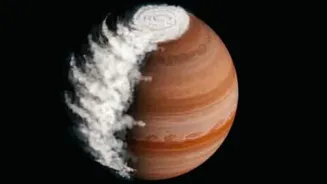
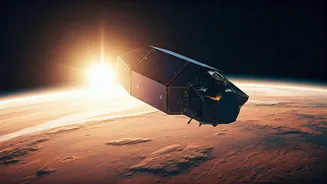
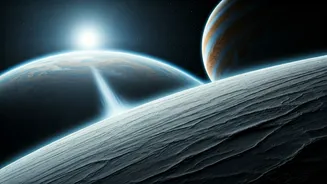
Despite the diminished confidence in the Europa plume hypothesis, the scientific community cannot entirely dismiss the possibility of their existence. Similar water vapor plumes have been more convincingly detected on Enceladus, another icy moon orbiting Saturn. Furthermore, Europa's sister moon, Io, known as the most volcanically active body in our solar system, exhibits eruptions of sulfur dioxide. These parallel phenomena suggest that icy moons are indeed dynamic environments capable of expelling material. The ultimate resolution to the question of Europa's water plumes and its presumed vast subsurface ocean, a key area of interest for astrobiologists seeking signs of extraterrestrial life, is anticipated with NASA's Europa Clipper mission. Scheduled to arrive in the Jovian system around 2030, this mission is specifically designed to investigate Europa's habitability and should provide definitive answers regarding these intriguing eruptions and the moon's hidden ocean.