






The Unescapable Grip
Beneath the serene facade of the night sky lie cosmic enigmas far more unsettling than imagined. Among these celestial anomalies, the black hole stands
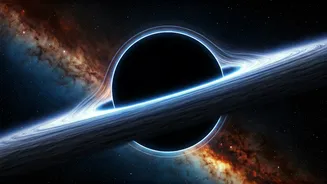
out as a paramount source of cosmic dread. Defined by NASA as an astronomical entity possessing a gravitational allure so potent that escape is impossible, not even for light itself, its power is absolute. The boundary marking this point of no return is termed the event horizon, where the required velocity to break free from its pull exceeds the universe's ultimate speed limit – the speed of light. This profound characteristic makes black holes uniquely terrifying, representing zones where the fundamental laws of the cosmos appear to be suspended or fundamentally altered, leaving anything that ventures too close irrevocably trapped within its silent maw.
Cosmic Birth and Silent Demise
The genesis of a black hole is a cataclysmic event rooted in the demise of massive stars. When stars with masses at least 8 to 20 times that of our Sun deplete their nuclear fuel, they succumb to an immense gravitational collapse. This catastrophic implosion often triggers a spectacular supernova explosion, a cosmic detonation that violently expels the star's outer layers. Meanwhile, the star's core is compressed into an incredibly dense point known as a singularity, from which nothing, not even light, can escape. Stellar-mass black holes, the most frequently encountered type, originate from the collapse of a single such gargantuan star. Because they neither emit nor reflect light directly, black holes themselves remain invisible. However, their presence is betrayed by the energetic radiation emitted by surrounding matter that is being inexorably drawn towards them, offering an indirect but potent means of detection.
Eerie Silence and Varied Scales
What amplifies the terror of black holes is their silent operation. Unlike explosive supernovae or colliding celestial bodies that announce their presence with immense cosmic fanfare, black holes operate in profound quietude. This silence stems from the vacuum of space, which lacks a medium for sound waves to propagate. Black holes possess no tangible parts that can collide and generate audible phenomena. They simply exist, subtly exerting their gravitational influence on everything in their vicinity. These cosmic vacuum cleaners manifest in a remarkable range of sizes, from hypothetical miniature black holes to the colossal supermassive black holes residing at the heart of galaxies like our own Milky Way, each posing a unique, silent threat.
Fascination Amidst Fear
Despite their frightening nature, black holes simultaneously ignite intense scientific curiosity. Researchers are drawn to them as cosmic laboratories for probing the ultimate limits of physics, aiming to unravel profound questions about stellar evolution, galactic formation, and the behavior of gravity under extreme conditions. These enigmatic entities push our understanding of the universe's fundamental laws to their breaking point, and with each new discovery, we gain a deeper appreciation for the vastness of our cosmic ignorance. For aspiring scientists and space enthusiasts alike, black holes serve as both a stark reminder of nature's awesome power and a compelling impetus for continued exploration and learning, embodying both a warning and a marvel.