







Revolutionary Mountain Transit
Breaking prior notions of India's longest funicular, the Shri Malanggad Funicular Railway, situated near Kalyan in Maharashtra, has redefined this unique
mode of transport. Though relatively short at 1.2 km, it stands as India's sole genuine funicular system, inaugurated in early 2026. This engineering feat significantly slashes the arduous journey time to a mere 10 minutes, a stark contrast to the two-hour travel previously required.
Understanding Funicular Principles
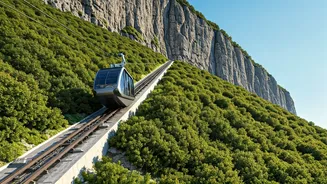
At its core, a funicular railway is ingeniously designed to navigate steep inclines, commonly found on mountainsides. Unlike conventional trains propelled by engines, this system employs a clever counterbalancing technique. It features two connected carriages that run on a track, linked by a robust cable passing over a pulley at the summit. As one carriage ascends, the weight of the descending carriage on the opposite track assists in its movement, creating a balanced and energy-efficient operation. This symbiotic relationship between the two cars is the hallmark of funicular technology.
Gateway to Haji Malang
The advent of the Shri Malanggad Funicular Railway has fundamentally altered the pilgrimage experience for visitors heading to the revered Haji Malang Dargah and the historic Malanggad Fort. What was once a demanding trek of over 2,500 stone steps, often taking considerable time and energy, is now a smooth, short ride lasting approximately ten minutes. This transformation is particularly beneficial for elderly pilgrims and those with mobility challenges, making a previously arduous journey remarkably accessible and far less taxing.
Steep Gradient Ascent
This remarkable funicular operates on a track stretching just over a kilometre, conquering a steep hillside with a significant 33-degree incline. This gradient makes it the longest system of its kind in India, gaining substantial height in its short run. The visual impression from the base clearly highlights the extreme steepness of the terrain, underscoring the necessity and effectiveness of this specialized transport solution. Each ride is capable of accommodating a substantial number of passengers, estimated between 90 and 120 individuals.
From Vision to Reality
The inception of this ambitious project dates back to around 2006, with the primary objective of alleviating the difficulties faced by devotees journeying to this significant religious site. The challenging mountain topography and the pronounced steepness presented considerable hurdles for the engineering teams. Upon finalization for implementation, the project's estimated cost was pegged at approximately Rs 90 crores, reflecting the complexity and scale of the undertaking.
Construction's Formidable Task
The construction phase of the Shri Malanggad Funicular Railway was fraught with significant engineering challenges. The hills surrounding Malanggad are predominantly composed of hard basalt rock, necessitating meticulous planning and considerable effort for excavation and groundwork. In numerous sections, the available space for deploying heavy machinery and equipment was extremely limited. Compounding these issues, the region's heavy monsoon season frequently disrupted progress, with torrential rains rendering the slopes precarious for work. These formidable conditions were substantial contributors to the project's extended development timeline.
Balanced System Operation
The operational mechanism of the funicular railway is a testament to its efficient design. The system fundamentally relies on the principle of balance, employing two interconnected carriages. A single cable links these carriages, ensuring that as one ascends, the other descends simultaneously, much like a rope over a pulley. The descending carriage's weight naturally aids in pulling the ascending one, thereby minimizing the energy input required for propulsion. This ingenious counterbalancing act is key to the system's smooth and economical functioning.
Transforming Visitor Experience
The impact of the funicular on visitors is immediate and profoundly positive. A climb that previously demanded hours of strenuous effort is now completed in just ten minutes. This dramatically improves accessibility for pilgrims, especially the elderly, who can now reach their destination without the physical toll of the steep ascent. Families, including those with young children, find the journey far more manageable and often describe it as a pleasant and novel experience, enhancing their overall visit to the site.