





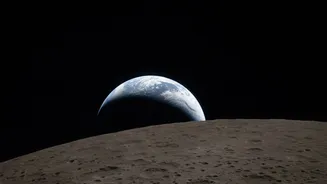
Oxygen From Regolith
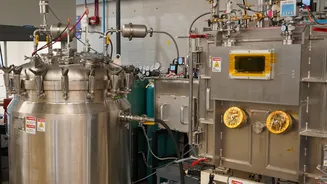
A significant stride towards establishing enduring human outposts beyond Earth has been achieved by Jeff Bezos' aerospace venture, Blue Origin. In controlled
laboratory settings, the company successfully extracted oxygen from material resembling lunar soil. This advancement is built upon years of dedicated scientific inquiry aimed at liberating oxygen chemically bound within the minerals that constitute a substantial portion of the Moon's surface. The capability to generate oxygen directly from regolith could drastically diminish reliance on exceedingly expensive supplies shipped from our home planet. Though this technology remains in its nascent phases, this pivotal development underscores how commercial space enterprises are now translating theoretical scientific principles into tangible systems crucial for upcoming lunar expeditions, potentially revolutionizing resource utilization in extraterrestrial environments.
Electrifying Lunar Soil
The method employed by Blue Origin is rooted in a process known as molten regolith electrolysis, a technique also explored by prominent entities such as NASA and the European Space Agency. The core of this approach involves heating lunar-like soil to exceptionally high temperatures, transforming it into a molten liquid state. Subsequently, an electric current is introduced into this molten material. This electrical energy serves to sever the chemical bonds that firmly hold oxygen atoms within the mineral structures. Once liberated, the oxygen gas can then be collected and utilized for various purposes. While the fundamental concept has been under investigation for quite some time, the present emphasis is increasingly shifting towards developing robust systems capable of functioning reliably under actual lunar environmental conditions, moving beyond the confines of laboratory experiments to practical application and deployment in space.
Oxygen Within The Moon
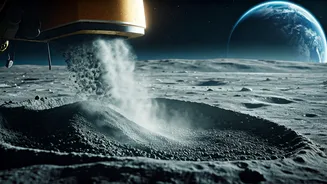
What might appear as inert lunar soil, scientifically termed regolith, actually harbors a surprisingly abundant reservoir of oxygen. An impressive 40% to 45% of its overall weight is attributed to oxygen chemically bonded within various minerals, including silica, iron oxides, and aluminum oxide. These mineral compositions are the result of billions of years of geological evolution, influenced by extensive volcanic activity and a relentless barrage of meteorite impacts across the lunar surface. Crucially, unlike the readily available atmospheric oxygen on Earth, this lunar oxygen is not present in a gaseous state. It remains firmly entrenched within solid compounds, necessitating energy-intensive methods for its extraction. Nevertheless, the sheer quantity of oxygen present in the lunar regolith positions it as an incredibly valuable resource for future human endeavors and sustained exploration efforts on the Moon.
Blue Origin's Lunar Vision
Founded by Jeff Bezos, Blue Origin is progressively concentrating its efforts on constructing the essential infrastructure required to support prolonged human habitation and activity on the Moon. The company is actively developing technologies designed to leverage local resources, thereby reducing the absolute necessity of transporting all provisions from Earth. This strategic direction encompasses the creation of systems capable of producing not only breathable oxygen but also metals and potentially even solar panels, all derived from lunar materials. Such advanced capabilities are fundamental to achieving the overarching objective of establishing self-sufficient lunar bases that can accommodate and sustain astronauts for extended durations, fostering a more permanent human presence in space.
The Energy Hurdle
A significant impediment to making oxygen extraction a practical reality on the Moon is the substantial amount of energy that the process demands. Heating the regolith to temperatures exceeding 1,600 degrees Celsius and sustaining the electrolysis reaction requires a constant and dependable power source. Future lunar missions are likely to depend on large-scale solar arrays strategically positioned in regions experiencing near-continuous sunlight, particularly around the lunar poles. Concurrently, space agencies are exploring the feasibility of compact nuclear reactors, which could provide a stable and unwavering energy supply irrespective of external environmental conditions. Without a reliable and consistent power generation solution, expanding this technology beyond its current laboratory-scale demonstrations will remain an exceptionally difficult challenge to overcome.
Building Blocks From Dust
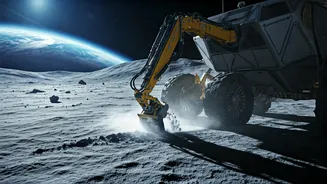
Beyond its primary function of producing oxygen, this groundbreaking process offers a substantial additional advantage: the generation of valuable byproducts. After the oxygen has been successfully extracted, the residual material comprises essential metals such as iron, aluminum, and silicon. These extracted metals possess immense potential for use in constructing habitats, fabricating tools, and manufacturing other critical infrastructure components directly on the lunar surface. This innovative strategy, known as in-situ resource utilization, promises to drastically reduce the overall cost and logistical complexities associated with space missions. Rather than bearing the immense expense and effort of transporting heavy construction materials from Earth, future lunar explorers could potentially fabricate necessary items using resources readily available on-site, fostering greater autonomy and efficiency.
Revolutionizing Space Travel
The expense and logistical challenges associated with transporting oxygen from Earth significantly constrain the duration and scope of astronaut missions in space. By enabling the production of oxygen directly on the Moon, space missions can achieve greater sustainability and reduce their dependence on frequent and costly resupply operations. Oxygen is not merely vital for respiration; it is also a fundamental component in the creation of water and serves as a crucial oxidizer in rocket propellants. Consequently, the Moon could eventually evolve into a strategic refueling point for spacecraft embarking on missions deeper into the solar system, including ambitious journeys towards Mars and beyond, thereby opening up new frontiers for human exploration and scientific discovery.
Towards Lunar Permanence
Although the technology for extracting oxygen from lunar dust has not yet been deployed in an actual lunar environment, its successful demonstration in controlled conditions represents a profoundly important milestone. Ambitious programs, such as NASA's Artemis initiative, are designed to establish a continuous human presence on the Moon's surface, and the ability to produce oxygen locally will be an absolutely critical component of these endeavors. By transforming what was once considered mere Moon dust into a usable and vital resource, scientists and private space companies are diligently laying the foundational groundwork for a future where humans can not only visit but also live and work on the Moon for extended periods, significantly advancing our interplanetary capabilities.