




Why Black Holes Matter
Black holes, those incredibly dense regions of spacetime, play a vital role in shaping the cosmos. They are not merely exotic theoretical objects but are critical
players in galaxy formation and evolution. Their intense gravity influences the movement of stars and gas, and their interactions can trigger bursts of energy across vast distances. Scientists study black holes to test Einstein's theory of general relativity, and they provide insights into the fundamental nature of gravity. Without the influence of black holes, the universe would appear very different than we observe today. Furthermore, they are excellent laboratories for exploring the extreme conditions of matter and energy. The study of black holes enhances our understanding of the universe's past, present, and potential future.
Supermassive Black Holes
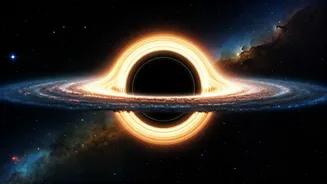
At the centers of most galaxies, including our Milky Way, reside supermassive black holes (SMBHs). These cosmic giants can have masses millions or even billions of times that of our sun. Their formation remains a subject of active research, but several theories exist. Some suggest they grow by accreting huge amounts of gas and dust from their surroundings. Others posit that they formed from the direct collapse of massive primordial stars in the early universe. The strong gravitational pull of SMBHs influences the orbits of stars and can trigger the formation of new stars. When material falls into an SMBH, it can form an accretion disk, which can emit tremendous amounts of energy in the form of radiation, making these black holes detectable even across vast cosmic distances. Understanding SMBHs is crucial to understanding how galaxies evolve.
Stellar-Mass Black Holes
Stellar-mass black holes are born from the remnants of massive stars that have reached the end of their lives. When a star much more massive than the sun exhausts its nuclear fuel, it can no longer support its own weight. The core collapses under immense gravity. This collapse triggers a supernova explosion, and if the core's mass is great enough, it will continue to compress into a singularity, a point of infinite density. These black holes typically have masses between 5 and 100 times that of the sun. Astronomers have identified many stellar-mass black holes through their effects on nearby stars, observing how the black holes' gravity affects the orbits of the stars. The detection of gravitational waves, generated by the collision of two stellar-mass black holes, provided further proof of their existence and dynamics.
Intermediate-Mass and Primordial
Intermediate-mass black holes (IMBHs) are a less understood class, with masses between 100 and 100,000 times that of the sun. Their existence has been inferred from observations in some globular clusters and dwarf galaxies, but finding definitive evidence has proven challenging. One theory suggests IMBHs might form from the mergers of smaller black holes, or perhaps in dense star clusters. Primordial black holes, another theoretical concept, are thought to have formed in the very early universe, potentially from density fluctuations in the early moments after the Big Bang. If they exist, they could vary greatly in mass, ranging from tiny objects to those comparable to stellar-mass black holes. The study of both IMBHs and primordial black holes helps test different cosmological models and could provide valuable insights into the early universe.
Giants, Ghosts, Gravity
Black holes come in many forms, each with unique characteristics and influences. Supermassive black holes dominate galactic centers. Stellar-mass black holes are the remnants of collapsed stars. Intermediate-mass black holes, if they exist, may reside in globular clusters. These are the giants. 'Ghosts' could be the remnants of stars or galaxies consumed long ago. Gravity is the driving force. Black holes warp spacetime, creating a gravitational pull so strong that nothing, not even light, can escape. Their presence shapes the cosmos. They influence the evolution of galaxies, fuel the activity of quasars, and are involved in spectacular cosmic events like the mergers of black holes, which astronomers can detect through gravitational waves. Learning about these cosmic entities continues to advance our understanding of how the universe works and what its future might hold.
Are Black Holes Dangerous?
The often-asked question about whether black holes pose a threat can be addressed. While the immense gravity of a black hole is a crucial characteristic, its danger depends on distance. Outside the event horizon, a safe distance from a black hole, the gravitational force is no stronger than that of other objects with similar mass. If our sun were replaced by a black hole of the same mass, Earth's orbit wouldn't change. However, as an object approaches the event horizon, the tidal forces (the difference in gravity between the near and far sides of the object) become significant. These forces would stretch the object vertically and compress it horizontally, a process called spaghettification. The likelihood of encountering a black hole near enough to be affected in this manner is extremely low, thus making it not a present danger to anyone. The primary danger comes from the black hole's gravitational impact, which could disrupt celestial orbits and potentially cause destructive events.
Black Holes Explained
Black holes are defined as regions in space where gravity is so strong that nothing, not even light, can escape. This intense gravitational pull arises from a concentration of mass compressed into an incredibly small space. The boundary around a black hole, from which nothing can escape, is called the event horizon. Crossing the event horizon is a point of no return. The nature of black holes is predicted by Einstein’s theory of general relativity. These gravitational entities form when massive stars collapse at the end of their lives or from the merger of smaller black holes. The study of black holes has provided key evidence for general relativity. The study also allows for the observation of how the universe is formed and its evolution.












![[WATCH] T20 World Cup 2026: Gautam Gambhir hosts dinner for Team India players ahead of Namibia clash](https://g-mob.glance-cdn.com/public/fc/image/7gXS1xdhs5Q0.webp)