





Economic Realities of Space
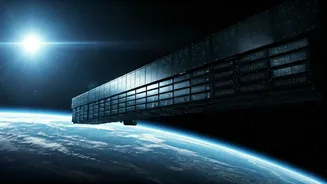
While the concept of placing data centers in the vast expanse of space might seem appealing, particularly for AI computation, Nvidia's CEO, Jensen Huang,
has provided a pragmatic perspective. He candidly stated during Nvidia's fourth-quarter earnings call that the current economic feasibility of such an endeavor is, to put it mildly, 'poor.' This suggests that the immense costs associated with launching, constructing, and maintaining such infrastructure in orbit far outweigh the immediate benefits. Despite this present-day limitation, Huang conveyed a forward-looking outlook, expressing confidence that these economic conditions are not static and are expected to see substantial improvement over time. This tempered optimism acknowledges the significant technological and financial hurdles that must be overcome before orbital data centers become a widespread reality.
The Allure of Space
One of the undeniable advantages of considering space for data center deployment is the sheer abundance of the resource itself – space. Huang pointed out that the operational environment in orbit is fundamentally different from Earth. He noted that while energy availability in space can be a consideration, particularly with reliance on solar power which requires large panels, there's an almost limitless supply of physical room. This contrasts sharply with the growing terrestrial challenges, where data centers are consuming vast amounts of energy and facing increasing scrutiny regarding their environmental impact and resource demands. The push for cleaner energy solutions and the often-complex bureaucratic processes for power acquisition on Earth are driving some of the interest in exploring off-world alternatives.
Industry Perspectives and Ambitions
The conversation around orbital data centers is not limited to Nvidia's leadership. Several prominent figures and companies in the tech industry are actively exploring or planning for such ventures. Elon Musk's xAI, for instance, is reportedly pursuing strategies to establish on-site power for its massive data centers, even utilizing mobile generators to expedite operations. This ambitious drive coincides with SpaceX's acquisition of xAI, suggesting a strategic alignment to fuel the buildout of these facilities. Musk himself has made bold predictions, forecasting that space will become the most cost-effective location for AI computations within a remarkably short timeframe, potentially as little as 30 to 36 months. Google's CEO, Sundar Pichai, has also indicated that the search giant is considering deploying data centers in space, potentially as early as next year, further signaling a broader industry trend towards investigating this extraterrestrial computing frontier.
Challenges and Skepticism
Not everyone in the tech elite shares the same fervent enthusiasm for immediate orbital data center deployment. OpenAI CEO Sam Altman, a former associate of Elon Musk, has voiced considerable skepticism, even going so far as to describe the current idea of placing data centers in space as 'ridiculous.' Altman's reservations stem from practical concerns, particularly the extraordinarily high costs associated with launching payloads into orbit and the inherent difficulties in performing maintenance and repairs on sensitive computing hardware in such an environment. He explicitly stated that, within the current decade, orbital data centers are unlikely to be a significant factor at scale. This dissenting view highlights the significant technological and economic barriers that still need to be surmounted before space-based data centers can transition from a futuristic concept to a viable, large-scale solution.