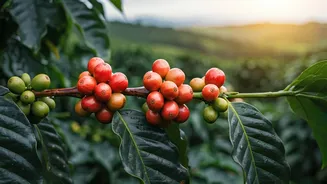








Climate's Impact on Coffee
Traditional coffee-growing areas in India, particularly in Karnataka's Kodagu, Chikkamagaluru, and Hassan districts, are experiencing significant disruptions
due to climate change. Planters report that the familiar agricultural cycles are no longer reliable, with the primary threat stemming from erratic weather patterns. The timing and intensity of rainfall, crucial for the flowering of Arabica and Robusta varieties, have become highly unpredictable. Coffee plants depend on precise rain sequences for blooming and subsequent fruit development; a timely shower initiates flowering, followed by a secondary rain event to set the fruit. However, recent years have seen deviations, with excessive rain, insufficient downpours, or mistimed precipitation severely impacting the delicate flowering process and, consequently, crop yields. Furthermore, extreme weather events are escalating in frequency. Last year, for instance, hailstorms devastated coffee flowers, leading to complete crop loss in affected areas. Unseasonal rains also complicate harvesting and compromise bean quality. Early showers, sometimes occurring as early as January, can force pickers to halt operations to avoid damaging new blossoms while ripe cherries are still on the plant. These rains also risk degrading or drying out ripe cherries, negatively affecting the final bean quality and flavour.
Emergence of Resilient Varieties
Amidst these climate-induced challenges, there's a growing interest in more robust coffee species, notably Liberica. Historically, Liberica was often cultivated as a secondary crop along farm boundaries rather than as a primary plantation variety. However, its superior resilience to changing environmental conditions is prompting a re-evaluation. Liberica coffee plants are characterized by their ability to withstand higher temperatures and possess deep, extensive root systems that enable them to access water from deeper soil layers, proving invaluable during drought periods. This species also demonstrates enhanced resistance to diseases like coffee leaf rust, a historically significant threat to coffee plantations. The physical structure of Liberica trees – being larger and sturdier – allows them to better endure heavy rainfall, storms, and the general variability of weather patterns. Its capacity to thrive in less fertile soils further solidifies its position as a promising alternative as global warming poses an increasing threat to conventional coffee cultivation. Beyond its resilience, Liberica is gaining traction due to its distinct flavour profile. Buyers both within India and internationally are increasingly drawn to its unique fruity and sweet notes, which offer a departure from the typical taste of Arabica and Robusta. Despite these advantages, Liberica cultivation still faces hurdles, primarily concerning yield. Currently, its production output is considerably lower compared to established varieties, partly because it is still largely managed as a 'tree coffee' rather than a fully integrated plantation crop.
Exploring Excelsa Coffee
Another variety being recognized for its climate resilience is Excelsa, often categorized alongside 'tree coffee' types. While its exact classification remains a subject of discussion, with some viewing it as a variant of Liberica due to shared characteristics, Excelsa exhibits a notable hardiness. It handles high temperatures, inconsistent rainfall, and humid tropical climates more effectively than the more climate-sensitive Coffea arabica. Sourcing Excelsa from estates like South Indian Coffee Company has become a focus for some specialty coffee businesses, though availability can be limited, often comprising experimental small-batch lots. Excelsa is noted for its rich body and distinctive cola-like undertones, offering a unique sensory experience for coffee enthusiasts. For fifth-generation coffee growers like Akshay Dashrath, Excelsa’s deep-rooted nature provides a significant advantage, especially in regions experiencing extreme moisture. He recounts instances where farms received an unusual amount of rainfall within a single month, conditions that would challenge Arabica and Robusta but are better tolerated by Excelsa. His estate in Coorg, for example, produces approximately three tonnes of clean Excelsa annually, showcasing its potential even in challenging conditions.
Planters' Adaptive Strategies
While the exploration of new coffee varieties is ongoing, many established planters are simultaneously implementing adaptive strategies to mitigate the effects of climate change on their existing crops. A significant challenge remains the limited availability of climate-resilient varieties, even from official sources, which has deterred widespread adoption. Nevertheless, proactive measures are being taken. Water conservation is a key focus, with planters investing in storage tanks and developing irrigation systems to manage drought conditions during critical flowering periods. Shade management practices are also being adjusted; maintaining a slightly denser canopy helps lower temperatures and reduce heat stress on coffee plants, albeit sometimes at the expense of reduced crop yield. This trade-off is considered necessary for long-term plant health and productivity. Furthermore, soil health has become a central concern. Techniques such as composting and incorporating organic matter are being employed to enhance the soil's water-retention capabilities, creating a more stable environment for coffee cultivation. These integrated approaches aim to build resilience from the ground up, complementing the introduction of new plant varieties.
Beyond New Varieties
The pursuit of climate resilience in Indian coffee cultivation extends beyond simply introducing new species; it encompasses a holistic approach to farming and processing. Certain established varieties, such as S795, continue to demonstrate remarkable performance. This Arabica selection is known for its high yield, inherent resistance to coffee leaf rust, and a desirable flavour profile featuring mocha or chocolate notes. Despite not being the most trendy, S795's genetic stability and adaptability to mid-elevation zones make it a reliable choice. With diligent harvesting and controlled fermentation, it can consistently produce clean cups with well-defined acidity and sweetness. Similarly, Selection 9, an Indian-developed Arabica variety resulting from a cross between Ethiopian Arabica and the rust-resistant Hibrido-de-Timor, remains a significant contributor. Industry observers emphasize that modern adaptation strategies are no longer confined to planting new varieties. Instead, they involve integrated thinking that includes canopy management, optimized plant spacing, meticulous moisture control, selective harvesting based on ripeness, and even adjustments to processing methods to accommodate inconsistent bean maturation. This comprehensive strategy reflects a deeper understanding of the complex interplay between climate, cultivation, and coffee quality.
Data-Driven Climate Insights
The conversation around climate change on coffee estates has undergone a significant transformation, shifting from cautious speculation to data-driven analysis and experiential learning. Younger generations of coffee producers are increasingly leveraging advanced modelling techniques to understand and predict climate-related risks. Farmers are diligently tracking crucial environmental indicators such as irregular blossom showers, temperature fluctuations during the fruit development stage, and unexpected rainfall during the drying process. These factors critically influence bean density, fermentation consistency, and ultimately, the quality of the final brew. The integration of this data allows for more informed decision-making and proactive adaptation. This evolution highlights that confronting climate change in coffee farming is not merely about adopting new species; it's about a comprehensive, integrated strategy. This includes refining canopy management, optimizing plant spacing, enhancing moisture retention through improved soil health and irrigation, implementing selective picking practices, and even adapting processing techniques to manage the variability in ripeness and bean quality. This multifaceted approach is essential for ensuring the long-term viability and sustainability of coffee cultivation in the face of a changing climate.