




Unveiling the Aurora
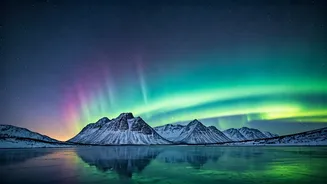
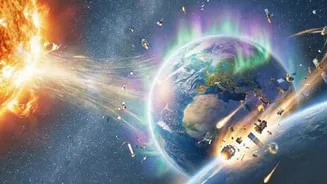
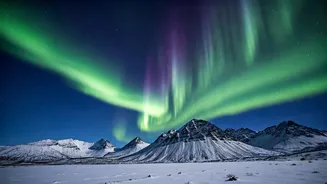
The aurora borealis, or Northern Lights, are a spectacular natural phenomenon caused by charged particles from the sun interacting with Earth's atmosphere.
These interactions, often triggered by solar flares and coronal mass ejections (CMEs), excite atmospheric gases, releasing energy in the form of light. The intensity and visibility of auroras are dictated by the strength and direction of these solar events, as well as Earth's magnetic field orientation. While primarily observed in high-latitude regions near the magnetic poles, geomagnetic storms can sometimes push auroral displays much farther south, offering a rare treat to mid-latitude observers. Understanding the Kp index, a measure of geomagnetic activity, is key to predicting aurora visibility. Higher Kp values, such as those above 4, indicate a greater chance of auroras appearing at lower latitudes. Factors like clear, dark skies and the phase of the moon also play a crucial role in successful aurora viewing. This guide delves into the science behind these celestial displays and provides insights into recent and upcoming solar activity that influences their appearance.
Solar Storm Watch
Geomagnetic storms, the driving force behind vibrant auroras, are a direct result of our sun's dynamic nature. These storms are primarily caused by two solar phenomena: fast solar wind streams emanating from coronal holes and coronal mass ejections (CMEs), which are massive expulsions of plasma and magnetic field from the sun's surface. Coronal holes are areas where the sun's magnetic field lines are open, allowing high-speed solar wind to escape into space. When these streams or CMEs are directed towards Earth, they can interact with our planet's magnetosphere, triggering geomagnetic disturbances. The strength of these storms is often categorized using the G-scale, with G1 indicating minor storms and G5 signifying extreme events. NOAA's Space Weather Prediction Center continuously monitors these solar activities, issuing watches and warnings to alert the public to potential geomagnetic storms and their aurora-producing capabilities. For instance, a significant geomagnetic storm was anticipated around December 24th to 25th due to an incoming CME, with forecasts suggesting G1 conditions, enhancing the possibility of auroras reaching mid-latitudes. Similarly, multiple CMEs were expected to influence Earth around October 16th to 17th, potentially leading to minor to moderate geomagnetic storms.
Aurora Forecasting
Predicting the best opportunities to witness the aurora borealis involves understanding various factors, from solar wind speeds to the orientation of the interplanetary magnetic field. Recent forecasts indicate a range of conditions. For example, on February 18th, minor G1 geomagnetic storms were possible due to a glancing blow from a coronal mass ejection (CME), with aurora activity expected to be confined to high latitudes. Conversely, a powerful X1.1-class solar flare on December 29th led to a G3 geomagnetic storm watch, with anticipated auroras visible as far south as Illinois and Oregon. The NOAA Space Weather Prediction Center provides crucial data, with Kp index predictions indicating potential activity levels. For instance, a Kp index peaking at 5 was expected around October 7th-8th, suggesting chances for minor to moderate storms. Even during quieter periods, such as February 23rd, where activity was expected to subside, a potential glancing blow from a CME on February 19th offered a slight possibility of aurora sightings extending further south. The presence of coronal holes, such as the one noted around December 10th, continuously feeds Earth with solar wind, maintaining a baseline chance for auroras at high latitudes. Additionally, events like the arrival of a co-rotating interaction region (CIR) around April 4th-5th can enhance space weather effects, potentially leading to G1 geomagnetic storm conditions.
Viewing the Lights
Witnessing the aurora borealis is an experience that requires not only favorable space weather conditions but also optimal viewing circumstances on Earth. For the best chance of spotting the Northern Lights, seek out locations with minimal light pollution and clear, dark skies, particularly away from urban centers. High-latitude regions, such as northern Canada, Alaska, Scandinavia, and parts of Scotland, offer the most consistent viewing opportunities. However, during periods of heightened geomagnetic activity, auroras can extend into mid-latitudes, sometimes reaching as far south as the northern United States or central Europe. For instance, a strong G3 geomagnetic storm on September 1st had the potential to spark auroras visible across Canada and Alaska, and even dip into northern parts of Europe. Similarly, a significant CME arrival on August 30th led to widespread auroras across Canada, Alaska, and possibly the northern U.S. The timing of these events is crucial; auroras are typically most visible between midnight and 3 a.m. local time. While forecasts provide valuable insights, real-time aurora trackers and aurora alert apps can offer up-to-the-minute information to help you catch these celestial displays. Remembering that the short summer nights in the Northern Hemisphere can limit viewing potential, while the longer winter nights in the Southern Hemisphere offer better contrast, is also key to a successful aurora hunt.