






A Bold New Crop
In Kundhei village, nestled within Odisha's Mayurbhanj district, the agricultural landscape was largely dominated by traditional crops like rice and maize,
yielding modest and predictable incomes. Fruit cultivation was a rarity, and the economic opportunities for the farming community were limited. This conventional approach, while stable, prevented significant financial growth. However, in October 2021, a visionary farmer named Bhaktosh Kumar Mahanta proposed a departure from the norm, introducing the concept of cultivating Taiwanese watermelons. He presented this exotic variety as a lucrative alternative, emphasizing its potential for high returns within a remarkably short cultivation cycle compared to their established crops.
The Experiment Begins
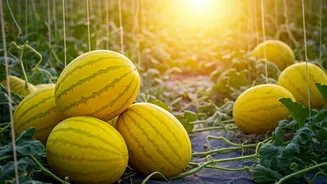
Mahanta's idea sparked interest, and three local farmers decided to embrace the challenge. Each invested approximately ₹50,000 to cultivate one acre of land. This investment covered essential inputs, including seeds, fertilizers, vermicompost, and neem flour, forming a comprehensive package for enhanced soil management and pest control. They opted for three distinct Taiwanese varieties: Aarohi, known for its distinct yellow flesh, and Vishala and Jannat, which also feature the signature sweet taste, though with red pulp. These Taiwanese breeds are celebrated for their vibrant hues and notably sweeter flavor profiles, setting them apart from local offerings.
Rapid Returns Realized
The initial season proved to be a resounding success, with farmer Sudhir Mahanta's plot serving as a prime example. The Taiwanese watermelons began to mature rapidly, with the first signs of ripening appearing around 30–35 days after sowing. The complete harvest was ready for market by mid-March. Crucially, these exotic melons commanded a premium price of ₹40–₹50 per kilogram, nearly double the ₹20 per kilogram fetched by ordinary local watermelons. This favorable market rate enabled Sudhir Mahanta to achieve an impressive revenue of approximately ₹2 lakh per acre. After accounting for all cultivation expenses, his net profit for the 90-day season stood at a remarkable ₹1.5 lakh per acre. An added benefit of this cultivation model is the land's immediate availability for subsequent rice cultivation within the same year, allowing for multiple income streams from a single plot.
Sweet Success Explained
The appeal of Taiwanese yellow watermelons lies in their unique characteristics and economic advantages. Unlike conventional watermelons with red flesh, these exotic varieties boast a striking bright yellow interior, coupled with an exceptionally sweet taste. Their rapid growth cycle means farmers can achieve a full harvest in approximately 90 days. Furthermore, their superior market value, often selling for nearly twice the price of local varieties, ensures substantial returns. This combination of desirable fruit traits, quick cultivation, and high profitability makes them a highly attractive option for farmers looking to diversify their crops and significantly enhance their annual earnings.