

Ancient Vedic Origins
The story of Malpua begins over 3,000 years ago, during the Vedic era in India, a time when food and spirituality were intrinsically linked. Back then,
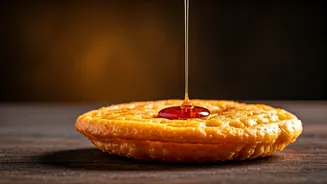
this delicacy, known as 'apupa,' was not just a culinary creation but also a sacred offering prepared for religious ceremonies. Its primary ingredients were simple yet foundational: barley flour, ghee, and honey, the principal sweetener of the time. This made 'apupa' a dish of both profound spiritual significance and practical sustenance. Its mentions are not confined to the Rigveda but also appear in ancient Buddhist and Jain texts, underscoring its deep cultural roots and widespread presence in early Indian society. This ancient preparation laid the groundwork for the myriad of sweet dishes that would follow in Indian cuisine.
Evolution and Regional Flavors
Over the millennia, Malpua transcended its ritualistic beginnings to become an integral part of everyday culinary traditions across India. Its remarkable adaptability has led to a diverse array of regional interpretations, each reflecting local tastes and ingredients. In Bengal, for instance, the batter is often infused with the distinct flavours of fennel seeds or shredded coconut, adding aromatic complexity. Bihar's version introduces mashed bananas, imparting a soft texture and natural sweetness. In Rajasthan and other parts of North India, Malpua is traditionally served with a rich, creamy accompaniment called rabri, transforming it into a celebratory treat. Meanwhile, in Odisha, particularly at the Jagannath Temple in Puri where it's offered daily as 'amalu,' the Malpua is prepared in a lighter, thinner style, maintaining its centuries-old spiritual connection. These variations highlight Malpua's journey from a simple barley-and-honey pancake to a multifaceted dessert enjoyed nationwide.
Pre-Sugar Sweetness
A key factor in Malpua's enduring legacy is its existence prior to the widespread availability and use of refined sugar in India. Many of the popular Indian sweets we know today, such as jalebi, gulab jamun, and barfi, emerged much later, coinciding with advancements in sugar production. Malpua, however, belongs to an earlier culinary epoch where sweetness was derived primarily from natural sources like honey and jaggery. This makes it a unique among Indian desserts, representing a time when culinary innovation was not dependent on processed sugars. Its ability to endure through such a significant shift in staple ingredients is a testament to its fundamental appeal and its deep entrenchment in the nation's food culture, distinguishing it as a dessert that predates the era of sugar-centric mithai.
Adaptation Through Time
As Indian agriculture, trade, and culinary practices evolved over centuries, Malpua naturally adapted to changing ingredient availability and palates. The foundational barley flour gradually made way for wheat flour and, in some areas, rice flour, catering to regional staples. Similarly, honey's dominance as a sweetener gave way to sugarcane juice and, eventually, refined sugar. Enhancements in flavour were introduced through the addition of milk, khoya (reduced milk solids), and aromatic spices like cardamom. By the medieval period, Malpua had found its way into royal kitchens, where it was often made richer and more elaborate. Despite these transformations, the core concept of a batter fried in fat and then sweetened has remained constant. This structural simplicity is precisely what allowed Malpua to evolve and adapt over countless generations without losing its essential identity, ensuring its survival as a beloved Indian sweet.
Timeless Cultural Relevance
Food historians widely acknowledge Malpua as the most ancient known dessert in India, with roots stretching back over 3,000 years to the Vedic period. The Rigveda's mention of 'apupa' describes an early version crafted from barley flour, fried in ghee, and sweetened with honey – a simple yet nourishing sweet devoid of sugar syrup, khoya, or elaborate garnishes. What truly sets Malpua apart is its remarkable continuity; unlike many ancient dishes that have faded into obscurity, Malpua has consistently evolved while remaining relevant. The Malpua savoured today is a direct descendant of its Vedic predecessor. Its presence continues to be felt strongly in contemporary Indian life, being prepared during major festivals like Holi, Diwali, Eid, and Janmashtami, sold by street vendors, and offered in temples. Many enjoy this sweet treat without realizing they are partaking in a culinary practice with a history spanning millennia, a testament to its enduring appeal and deep cultural significance.