






The Goan Kunbi Drape
Often overlooked in favor of Goa's popular beach image, the Kunbi saree offers a fascinating glimpse into the region's tribal past. Traditionally worn
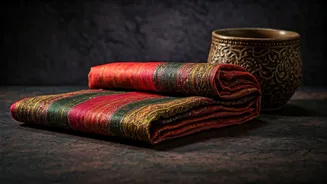
by indigenous communities, this striking red and black checkered fabric was masterfully crafted on backstrap looms. Its minimalist design, featuring a shorter drape worn without a blouse or petticoat, was ingeniously practical for the agricultural work of paddy field laborers. The influence of colonial dress codes and the advent of modern power looms sadly diminished its prevalence, leaving only a handful of weavers preserving this unique technique. The Kunbi's inherent breathability and simple aesthetic make it remarkably suited for today's fashion landscape, representing a blend of historical significance and modern appeal.
Saurashtrian Sungudi
From the southern region of Madurai, the Sungudi saree showcases the intricate artistry of Saurashtrian weavers. The creation of authentic Sungudi is a testament to meticulous handwork, involving the painstaking process of tying thousands of minute knots before the fine cotton fabric is immersed in natural dyes. This traditional method results in a garment that is exceptionally breathable, making it an ideal choice for the intense heat of Southern Indian summers. Regrettably, the market today is largely inundated with screen-printed imitations, which lack the depth and authenticity of the original hand-knotted and dyed Sungudi. Reviving genuine Sungudi production would celebrate this artisanal skill and offer a truly superior textile experience.
Maharashtra's Karvath Kati
While the opulent Paithani sarees often capture the limelight in Maharashtra, the Karvath Kati weave from the Vidarbha region faces neglect. Crafted from pure, wild Tussar silk, this saree derives its distinctive name from its borders, which are adorned with geometric patterns resembling saw teeth – hence, 'Karvath'. Its beauty lies in its profound, earthy elegance, offering a unique aesthetic that easily distinguishes itself from heavily embellished silk varieties. The struggle of its weavers highlights the importance of supporting diverse regional textile traditions that possess their own inherent charm and sophisticated appeal, moving beyond mainstream popularity.
North Karnataka's Patteda Anchu
Originating from North Karnataka and dating back to the 10th century, the Patteda Anchu saree stands as a remarkable example of ancient sustainable textile practices. This robust cotton saree is characterized by a prominent mustard or red border set against a subtly checked body. Its genius lies in its complete reversibility, allowing it to be worn on either side, thereby maximizing its utility. Furthermore, the Patteda Anchu requires no additional fall or lining, and notably, zero ironing, embodying the essence of zero-maintenance clothing. Its decline in popularity occurred as inexpensive synthetic fabrics permeated rural markets, but its eco-friendly and low-maintenance qualities make it an unparalleled garment for conscious consumers.
Telangana's Gollabhama
The Siddipet Gollabhama saree is a narrative woven into fabric, featuring intricate motifs of a 'Gollabhama,' or milkmaid, gracefully carrying a pot. These captivating images are not added through embroidery but are painstakingly woven directly into the textile using a complex extra-weft technique. This method is incredibly labor-intensive, and the insufficient compensation for such slow, meticulous craftsmanship has led many younger artisans to abandon the tradition. Preserving the Gollabhama weave is crucial to safeguarding a unique form of textile storytelling and ensuring that this detailed artisanal skill is not lost to future generations.
Aurangabad's Himroo
Hailing from Aurangabad with historical ties to the Mughal era, Himroo represents an ingenious fusion of silk and cotton. The name 'Himroo' is derived from the Persian word 'Hum-ruh,' meaning 'similar,' alluding to its resemblance to pure silk. This weaving technique allows for the creation of garments that possess the luxurious appearance of heavy brocade while remaining exceptionally breathable, making them perfectly suited for India's warmer climates. The challenge today is the prevalence of cheap power-loom imitations that are deceptively marketed as authentic Himroo, threatening the livelihood of genuine artisans and diluting the legacy of this sophisticated textile.
Gujarat's Mashru Weave
From Patan, Gujarat, comes Mashru, a fabric whose name translates to 'permitted' in Arabic. Its development was a clever response to religious proscriptions that prohibited Muslim men from wearing pure silk directly against their skin. The solution was a masterfully engineered weave that features opulent silk on the exterior while maintaining a soft cotton lining on the interior. This construction offers a unique 'comfort-luxury' experience, providing the richness of silk with the ease of cotton. However, the availability of genuine, handwoven Mashru has become exceedingly rare in contemporary markets.