




Power Crisis Unfolds
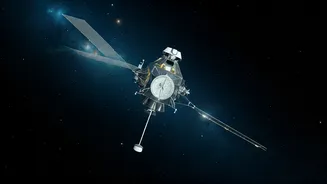
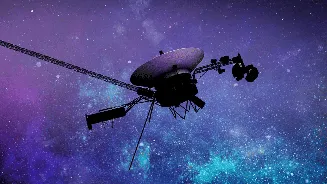
The venerable Voyager 1 spacecraft, a pioneer in deep space exploration, is confronting a significant challenge stemming from its aging power source. The radioisotope
thermoelectric generator (RTG), which has reliably converted the heat from decaying plutonium into electricity since the spacecraft's launch in 1977, is steadily losing its output. Initially generating around 470 watts for its intended five-year mission, the RTG now loses approximately 4 watts annually. By 2019, its power reserves had fallen below 270 watts, and this decline continues. This gradual depletion necessitated a difficult decision: temporarily deactivating the Low-energy Charged Particles (LECP) experiment to conserve energy and prevent the spacecraft from automatically shutting down essential systems via its undervoltage protection mechanism. This measure ensures manual control remains with the flight team, a crucial aspect for extending its mission, ideally beyond its 50th year.
LECP's Vital Role
The Low-energy Charged Particles (LECP) experiment, despite being temporarily powered down, has been instrumental in our understanding of the vast cosmic environment beyond our solar system. This instrument meticulously measures ions, electrons, and cosmic rays originating from both within our solar system and the surrounding interstellar medium. NASA highlights that the data gathered by LECP has been invaluable, providing critical insights into the structure of the interstellar medium itself. It has been instrumental in detecting pressure fronts and identifying regions where particle density varies significantly in the space beyond the heliosphere, our Sun's protective magnetic bubble. The decision to switch it off was not taken lightly, underscoring the spacecraft's dwindling power reserves and the imperative to prioritize which scientific endeavors can continue to ensure Voyager 1's longevity.
Unexpected Power Drop
While the steady decline of the RTG's power output was anticipated, a sudden and unexpected drop occurred in February due to a planned roll maneuver. This maneuver, intended for operational purposes, caused a more abrupt decrease in power than foreseen. Fortunately, NASA's Jet Propulsion Laboratory (JPL) had already devised contingency plans for such eventualities. One of these contingencies involved the temporary deactivation of the LECP. To facilitate a potential future reactivation, the flight team did not completely shut down the instrument; they kept its small motor running, consuming a minimal 0.5 watts. This strategic decision aims to simplify the process of bringing the LECP back online should conditions permit, allowing it to resume its vital data collection.
The 'Big Bang' Fix
Given Voyager 1's immense distance from Earth—over a light-day away—refueling is practically impossible. In response to this power challenge, engineers are developing an ambitious energy conservation strategy dubbed 'the Big Bang.' This innovative approach involves swapping out several powered devices on both Voyager 1 and Voyager 2 with more power-efficient alternatives. The primary goal is to significantly reduce the overall power consumption of the probes, thereby extending the operational lifespan of their RTGs. The initial implementation of this fix is slated for Voyager 2, which is currently closer to Earth. If this trial proves successful, the 'Big Bang' solution will then be deployed on Voyager 1. Should all stages of this plan proceed smoothly, there's a tangible possibility that the LECP could be reactivated, enabling the aging spacecraft to continue its groundbreaking scientific mission well into the future, far beyond its originally planned retirement.