







New Satellite Network
The U.S. Space Force has committed a substantial $437.6 million to two leading satellite operators, Viasat and SES, for the development of an advanced
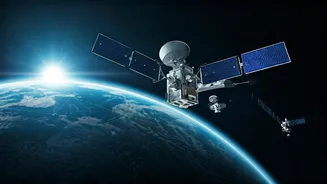
communications satellite network. This initiative, known as the Protected Tactical Satcom-Global program (PTS-G), is specifically engineered to bolster the resilience of military communications against sophisticated jamming techniques and cyber intrusions. The core concept of PTS-G involves deploying a constellation of smaller satellites, leveraging commercial off-the-shelf technology, to provide secure and reliable communication links from geostationary orbit. This strategic move aims to modernize the military's ability to communicate effectively across diverse and challenging operational environments, ensuring continuous connectivity even under duress.
Swarm Architecture Explained
The PTS-G program introduces an innovative 'swarm' architecture, a departure from traditional large, single-satellite systems. This approach distributes communication capabilities across multiple smaller satellites working in concert. The strategic advantage of this swarm formation is its enhanced survivability and operational continuity. Should any single satellite in the network experience disruption or failure, the overall communication coverage across a region is not critically compromised. This distributed model significantly boosts the system's resilience. Pentagon budget documents indicate that the initial deployment, termed 'Swarm 1,' will comprise four spacecraft, with Viasat and SES each responsible for constructing two satellites. These initial units are projected for delivery by March 2029.
Technological Foundation
The newly contracted satellites for the PTS-G initiative will operate on X-band and military Ka-band frequencies. These specific radio frequency bands are extensively utilized in military operations due to their robust performance characteristics. The selection of Viasat and SES was not arbitrary; they emerged from an initial group of five companies that had previously developed demonstration payloads for the program. This preliminary phase involved companies like Astranis, Boeing, and Northrop Grumman, underscoring the competitive and rigorous selection process. A Viasat representative has previously indicated that their contribution to PTS-G involves designing a dual-band X-Ka satellite, incorporating technology derived from their Viasat-3 broadband satellite constellation, demonstrating a strong foundation in advanced satellite technology.
Future Deployments Planned
The Space Force's vision for the PTS-G program extends beyond the initial deployment. Pentagon budget documentation reveals plans for a subsequent procurement phase scheduled for 2028. This second round of acquisitions will focus on an additional four PTS-G satellites, building upon the success and lessons learned from the first swarm. The anticipated deployment for this second batch of satellites is slated for 2031. This phased approach ensures continuous enhancement and expansion of the military's satellite communication capabilities, demonstrating a long-term commitment to maintaining a technologically superior and operationally resilient network capable of meeting future defense challenges.