




A Cosmic Observer
The Nancy Grace Roman Space Telescope, previously known as the Wide Field Infrared Survey Telescope (WFIRST), represents NASA's commitment to pushing the boundaries
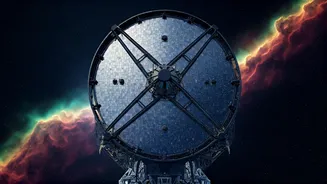
of space exploration. Named in honor of the agency's first chief astronomer, Dr. Nancy Grace Roman, it continues the legacy of Hubble and introduces several enhancements. Scheduled for launch in the late 2020s, the Roman Space Telescope will primarily focus on unraveling the mysteries of dark energy, one of the most puzzling phenomena in the universe. It will map the distribution of dark matter, search for exoplanets, and image vast areas of the cosmos with exceptional clarity, thanks to its wide field of view. The telescope's primary mirror will be approximately 2.4 meters (7.9 feet) in diameter, similar to Hubble's, and will be equipped with advanced instruments designed to observe in infrared wavelengths, allowing it to see through cosmic dust and detect faint objects.
Dark Energy Unveiled
One of Roman's main missions is to shed light on dark energy, the mysterious force causing the universe's accelerated expansion. While scientists know dark energy exists, its nature remains largely unknown. Roman will use its wide field of view and advanced instruments to survey billions of galaxies, creating a three-dimensional map of the universe. By analyzing the distribution of these galaxies and observing how light from distant objects is distorted by the expansion of space (a phenomenon known as weak gravitational lensing), Roman will measure the effects of dark energy with unprecedented precision. This data will help researchers determine if dark energy is a constant, as currently believed, or if it is changing over time. Furthermore, the telescope will provide information on how dark energy has influenced the structure of the universe, potentially revealing clues about its fundamental properties. The mission aims to refine our understanding of cosmology and the fate of the universe.
Exoplanet Hunting
Besides studying dark energy, the Roman Space Telescope is designed to discover and characterize exoplanets, planets orbiting stars other than our Sun. It will employ two primary methods for this: microlensing and direct imaging. Microlensing relies on the gravitational effects of a foreground star and planet bending and magnifying the light from a background star. Roman's wide field of view allows it to monitor millions of stars simultaneously, dramatically increasing the chances of detecting exoplanets. The telescope is also equipped with a coronagraph, an instrument designed to block the light from a star, allowing the observation of faint planets orbiting nearby. Direct imaging is more challenging but offers the opportunity to capture images of exoplanets and study their atmospheres. The combination of these methods will allow Roman to detect both small, rocky planets similar to Earth and gas giants, providing valuable data on the diversity of planetary systems in the Milky Way.
Advanced Technology Used
The Roman Space Telescope leverages cutting-edge technology to achieve its ambitious scientific goals. Its primary instrument is the Wide Field Imager, a powerful camera with a field of view 100 times larger than Hubble's, which means it can survey vast swaths of the sky rapidly. This instrument enables the detailed mapping of galaxies and the detection of faint objects, crucial for studying dark energy and mapping the cosmos. The Coronagraph Instrument, used for direct imaging of exoplanets, is another key component. This technology allows Roman to directly observe exoplanets by suppressing the overwhelming light from their host stars. This instrument will enable astronomers to study the composition of exoplanet atmospheres and search for signs of habitability. The Roman Space Telescope will be equipped with advanced detectors and processing systems, enabling it to collect and analyze enormous amounts of data. This data will be used to create detailed maps and images of the universe, providing insights into some of its most intriguing secrets.
Impact and Future
The Nancy Grace Roman Space Telescope holds the potential to revolutionize our understanding of the universe. By studying dark energy, it can change our fundamental understanding of cosmology and the fate of the universe. The exoplanet survey will unveil countless new worlds and provide a deeper understanding of how planetary systems form and evolve. The data from Roman will be invaluable for future missions, including those designed to search for signs of life beyond Earth. The mission's success relies on international collaboration, bringing together scientists and engineers worldwide. The Roman Space Telescope represents a major leap forward in space exploration, promising to answer some of the most profound questions about the universe, its composition, and our place within it. It will also inspire the next generation of scientists and astronomers and encourage the public's excitement and curiosity about the cosmos.