




Cooling Core Principle
Ensuring food safety with leftovers hinges on a fundamental concept: rapid cooling. When hot food, especially in large quantities like soups or stews,
is left in deep containers, the center remains warm long after the edges have begun to cool. This prolonged warm period, particularly between 140°F and 40°F (60°C and 4°C), is an ideal breeding ground for dangerous bacteria such as Bacillus cereus and Clostridium perfringens. The 'two-inch rule' addresses this by ensuring that food cools down to a safe temperature within a shallow depth. Specifically, by cooling food to a depth of no more than five centimeters (approximately two inches) from any surface, heat is released significantly faster. This drastically reduces the time food spends in the temperature danger zone, effectively halting bacterial proliferation and making your leftovers safe to consume. This principle is vital for maintaining both the taste and safety of your culinary creations, especially when dealing with hearty, slow-cooked dishes.
Shallow Containers Advantage
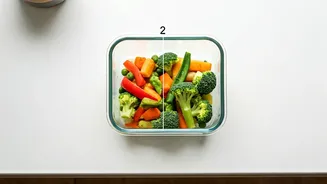
The effectiveness of the 'two-inch rule' is directly tied to the choice of storage containers. Large, deep pots or bowls create a thermal mass that insulates the food, preventing rapid cooling. In contrast, utilizing shallow dishes dramatically increases the surface area exposed to the cold. This increased surface area allows your refrigerator's cold air to circulate more efficiently around the food, drawing out heat at a much faster rate. By dispersing hot food into thinner layers across several shallow containers, you facilitate quicker and more uniform cooling. This method significantly accelerates the process of bringing the entire dish down to the safe temperature range of below 40°F. It's a straightforward yet powerful strategy that professional kitchens employ to manage food safely, and it's easily adaptable for home cooks aiming to preserve large batches of food, like seasonal harvests or family-sized meals, without compromising safety.
Smart Refrigeration Practices
Beyond the container choice, how you store food within your refrigerator also plays a crucial role in maintaining safety and freshness. A common inclination is to immediately seal hot dishes with their lids to prevent spills, but this traps heat, counteracting cooling efforts. A more effective approach is to leave the lid slightly ajar or loosely cover the dish with aluminum foil until it has completely cooled. Furthermore, crowded refrigerator shelves can impede crucial air circulation. For optimal cooling, ensure your shallow containers have adequate space around them to allow cold air to flow freely. Stacking containers too tightly or pushing them into corners can create warm pockets. Giving your leftovers 'breathing room' ensures that the cold air can effectively reach and cool all surfaces of the food, facilitating rapid temperature reduction and preventing bacterial growth, thereby maintaining the integrity and safety of your carefully prepared meals.