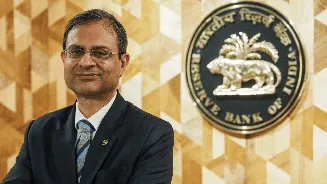









RBI Policy & Market Reaction
The Reserve Bank of India's recent monetary policy decisions have captured significant market attention, with a focus on maintaining the repo rate while
providing crucial support to the Indian Rupee. This strategic approach aims to balance inflation control with economic expansion, particularly in the face of global oil price volatility and persistent inflationary pressures. Experts suggest that the RBI's firm stance on its 4% inflation target, coupled with the potential for one to two rate hikes if inflation proves stubborn, signals a cautious yet determined effort to ensure macroeconomic stability. Following the policy announcement, the Rupee showed notable strength, appreciating by approximately 81 paise against the US Dollar, which was attributed to increased foreign exchange inflows. This positive market reaction underscores investor confidence in the RBI's ability to navigate economic challenges and maintain a stable financial environment, even as the central bank considers proposals like polymer currency notes to enhance currency durability.
Forex Reserves Surge
India's foreign exchange reserves have witnessed a remarkable surge, reaching a substantial $682 billion. This significant accumulation of reserves provides a robust buffer, estimated to cover approximately 11 months of import costs, significantly bolstering the nation's external payment capacity. This increase, partly driven by the weakening of the US Dollar against major currencies and by foreign institutional investors (FIIs) re-entering the Indian debt market following the waiving of capital gains tax on government securities, demonstrates strong international investor confidence. The decision to exempt foreign investors from capital gains tax on government bonds is a strategic move designed to attract more foreign investment, further strengthening the Rupee and stabilizing the financial markets. This robust forex position is a critical component of India's economic resilience, enabling it to withstand external shocks and support its growth ambitions.
Economic Growth & Sectoral Drivers
India continues to showcase an impressive economic growth trajectory, with the GDP expanding by an estimated 7.7%. This robust performance is fueled by a combination of strong domestic demand and strategic government initiatives aimed at boosting manufacturing and promoting sustainable development. For instance, the government's push for ethanol fuel is evident in the rollout of 100 ethanol fuel stations nationwide, aligning with the goal to cut fuel imports and enhance energy security. Companies like Maruti Suzuki are investing significantly in green energy and promoting flex-fuel vehicles, contributing to reduced energy import bills. Furthermore, the expansion of the renewable energy sector, highlighted by significant investments in solar projects and green hydrogen, alongside a growing focus on AI adoption for streamlining standards and reducing compliance burdens, indicates a dynamic and forward-looking economic landscape. The planned introduction of E85 flex-fuel and the expansion of electric vehicle charging infrastructure further underscore India's commitment to a greener and more self-reliant energy future.
Investment & Infrastructure Development
India's economic dynamism is further evidenced by substantial investments flowing into key infrastructure and manufacturing sectors. Large conglomerates are making significant capital commitments, such as L&T's Rs 18,600 crore investment in Tamil Nadu, projected to create 8,000 jobs, and Maruti Suzuki's Rs 925 crore investment in green energy by FY31. The real estate sector is also seeing considerable activity, with major projects like a Rs 250 crore housing project in Delhi's Rohini and a Rs 2,000 crore township in Goa. In the realm of renewable energy, significant capital is being deployed, with Inox Clean acquiring a 6 GW renewable energy portfolio for ₹6,000 crore and ACME Solar raising Rs 2,800 crore through a QIP. The government's focus on semiconductors is also notable, with amendments to the Semiconductor Policy 2024 in Uttar Pradesh aimed at attracting further investment. These widespread investments highlight a strong appetite for growth and a commitment to building a robust economic foundation across diverse industries.