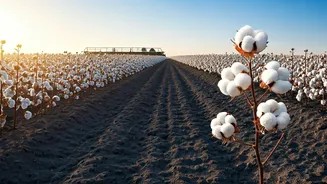








Akola: A Cotton Hub
Nestled in Maharashtra's Vidarbha region, Akola stands as a testament to India's enduring connection with cotton. This city is more than just a locale
for cotton cultivation; it functions as a comprehensive ecosystem dedicated to this vital crop. The agricultural landscape surrounding Akola is graced with exceptionally fertile black soil, an environment perfectly suited for growing high-quality cotton. This natural advantage has enabled the region to evolve over generations into one of the country's foremost cotton-producing areas. Beyond mere cultivation, Akola has established itself as a significant center for the processing and trading of cotton. Numerous ginning facilities, where cotton fibers are meticulously separated from their seeds, are dispersed throughout the area, feeding directly into the extensive Indian textile supply chain. Historically, cotton originating from Akola has been a subject of large-scale commercial transactions, positioning the city as a critical marketplace not only for cotton itself but also for related products like oil and other agricultural commodities. A particularly noteworthy innovation contributing to Akola's prominence is the 'Akola pattern,' a sophisticated high-density cotton farming method developed locally. This technique empowers farmers to achieve superior yields from the same arable land, underscoring the city's commitment to its cotton legacy and its continuous drive for agricultural advancement.
Yavatmal's Cotton Significance
Complementing Akola's status, Yavatmal emerges as another cornerstone of Maharashtra's flourishing cotton industry. Recognized as one of the largest cotton-producing districts within the state, a substantial segment of its agricultural community relies heavily on cotton cultivation for their primary income. The sheer volume of cotton harvested in Yavatmal annually makes its contribution indispensable when discussing India's overall cotton output. Consequently, the district plays a substantial role in bolstering both Maharashtra's and the nation's aggregate cotton supply, a fact that has rightfully earned it the esteemed 'Cotton City' designation over time. In tandem, Akola and Yavatmal collectively form the bedrock of the Vidarbha region's cotton belt. These two cities operate in concert, synergistically contributing to the sustained strength and prosperity of India's extensive cotton industry. Their parallel efforts ensure a consistent and abundant supply of cotton, vital for the nation's textile production and agricultural economy.
Centuries of Cotton Tradition
The deep-rooted cotton culture prevalent in the Vidarbha region is not a recent development; its origins stretch back across centuries, deeply embedded in the area's historical fabric. For an extended period, the Vidarbha territory has been intrinsically linked with cotton farming. During the era of British colonial rule, cotton cultivated in this region was actively exported to textile mills, both within India's borders and to international markets, establishing it as a commercially valuable territory even in those times. The British colonial administration was quick to recognize the superior quality of Vidarbha's cotton, and the region's reputation for excellence only continued to grow. What began as a traditional farming practice has, over the passage of time, transformed into a fully developed and integrated cotton belt. This transformation includes the establishment of thriving markets, sophisticated processing units, expansive trading networks, and vital industrial connections. This prolonged and rich history is a significant factor contributing to why these cities continue to embody the prestigious 'Cotton City' identity even today, carrying forward a legacy built over generations.
Meaning of 'Cotton City'
The title of 'Cotton City' extends beyond a mere catchy appellation; it signifies a profound economic and social importance for the cities it represents. For the dedicated farmers of Akola and Yavatmal, cotton is not simply a crop to be harvested; it embodies their livelihood, their very identity, and their deep-seated connection to the land they cultivate. Being recognized as a 'Cotton City' shines a spotlight on the immense hard work and perseverance these agricultural communities demonstrate year after year. On a broader scale, these cities serve as vital economic engines, supporting thousands of employment opportunities within the extensive textile and processing industries. This employment spectrum ranges from the manual laborers in the ginning units to the traders who manage the commerce and the transporters who move the goods. Furthermore, their contributions are instrumental in maintaining India's standing as one of the world's leading cotton producers. This global position has direct and substantial implications for the country's export revenues, overall employment rates, and the broader economic landscape. Akola and Yavatmal are far more than just geographical locations on a map; they are living affirmations of how a single agricultural commodity can profoundly shape the character and identity of an entire region. From the expansive black soil fields that characterize Vidarbha to the ever-present hum of the ginning mills, every element of these cities tells the compelling story of cotton. Their contribution to India's agricultural and textile economy is immense, and their legacy continues to flourish with each passing harvest season. The next time you encounter a cotton garment or bedding, it's highly probable that its journey began in one of these two remarkable cities in Maharashtra.