





Lunar Spectacles Unveiled
Throughout the year, the moon offers a consistently captivating spectacle, presenting itself in various phases and positions relative to other celestial
bodies. In late December 2025, observers could witness a crescent moon accompanied by Earthshine, a delicate illumination of the moon's unlit portion by sunlight reflecting off Earth. Later, on December 22nd and 23rd, similar sightings of the crescent moon with Earthshine were possible. January 2026 featured a young crescent moon after dark on the 19th and a pre-eclipse moon near Regulus on the 2nd and March 1st. Notably, a full 'Snow Moon' rose with Regulus on February 1st, and a 'Ramadan Moon' appeared on February 18th. The moon's dance continued with it occulting Regulus on February 2nd, visiting the Pleiades on February 23rd and December 30th, and appearing near the bull's horns on January 28th and February 25th. Early mornings offered views of a waning crescent moon on January 16th and a 'morning Moon' with Spica on March 6th. The year also highlighted specific lunar phases like the first quarter moon on January 25th and a first-quarter perigee moon on February 24th. A particularly anticipated event was the total lunar eclipse on March 3rd, preceded by moon sightings that helped plan its observation. The new moon on February 17th coincided with an Antarctic 'ring of fire' eclipse.
Planetary Parades & Bright Stars
The planets put on an impressive show throughout the period, with several notable alignments and appearances. Jupiter dominated the evening sky on February 3rd and was at its February best on the 15th, having been at opposition on January 10th. A 'planetary parade' was a recurring theme, with a mini-parade visible on an unspecified date and another on February 8th after sunset. February 2026 was highlighted for its 'rare planetary alignment,' promising an exciting planet parade, and specific gear recommendations were offered for viewing it. March brought a different planetary conjunction, with Venus and Saturn appearing together in twilight on March 7th and 8th. Mercury was at its evening best on February 20th, and its post-sunset visibility was also noted around February 18th. Saturn was paired with a waxing crescent moon on January 21st and 22nd, and a crescent moon waved goodbye to it on January 23rd. The brightest planets of February 2026 were a focus, and a rare 6-planet parade spanning nearly 180 degrees was captured by an astrophotographer. The brightest planets in March's night sky were also detailed for viewing. Other celestial highlights included Jupiter as the 'Christmas Star' on December 20th.
Constellations & Cosmic Phenomena
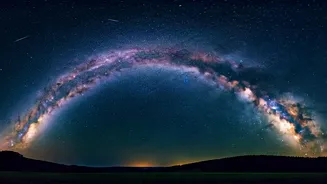
Beyond the moon and planets, the night sky offered a rich tapestry of constellations and other fascinating astronomical phenomena. Orion was a prominent figure, with his belt visible on February 16th and his sword on December 18th. The constellation was also featured on February 5th alongside his 'dogs.' Leo, the 'herald of spring,' appeared on February 7th, and the constellation Taurus, with its 'big V,' was visible on January 7th. Winter constellations were highlighted on February 21st and March 4th. The Winter Hexagon was a notable feature on January 12th, and the Winter Triangle took flight on February 22nd. The celestial 'G' was visible on February 9th, and Ursa Minor constellation was observable on December 29th. Ursa Major rising was noted on January 17th. The circumpolar sky was explored on January 9th, and Polaris, the North Star, was a key feature on January 18th. The 'Hole in the Sky' phenomenon was visible on January 8th. The winter Milky Way was present on December 19th and February 4th. A celestial rectangle was visible on February 26th. The 'Wintermaker' was observable on January 13th. Two unique phenomena were the 'Zodiacal light,' visible on March 5th and February 14th, with guidance on how to see it in March, and a 'tail of lights' on February 27th. The Quadrantid meteor shower peaked in the early hours of January 4th, and the Ursids meteor shower peaked on December 21st. Finally, the 'celestial collapse' occurred on January 30th.