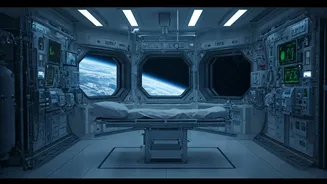







Emergency Evacuation Initiated
NASA's decision to bring home the Crew-11 astronauts early from the International Space Station (ISS) was prompted by a medical issue that arose in space.
The agency set a return date of January 14, 2026, to ensure the astronauts' well-being. This was not the first time NASA has handled medical challenges in space, with past incidents setting the groundwork for managing such occurrences. The urgency of the situation prompted a quick packing process within the Dragon spacecraft as astronauts prepared for their departure. While the specific nature of the medical concern was not disclosed, NASA confirmed that the issue did not stem from an injury. Before departing, the crew conducted suit tests and finalized their preparations. The timeline was compressed, with the Crew-11 team conducting final science experiments before their journey back to Earth. NASA and SpaceX had to evaluate various splashdown options to guarantee a safe return for the astronauts. Despite the immediate concern of the medical evacuation, the mission control was coordinating to manage the transition smoothly and efficiently, focusing on the crew's health and safety.
Preparing for Departure
As the date for their departure approached, the Crew-11 astronauts meticulously prepared for their early return to Earth. This involved testing their spacesuits and packing the Dragon spacecraft, a process critical for a smooth and safe journey back. During this time, the team was able to fit in a bit of last-minute science, maximizing their time in space before leaving. A poignant change-of-command ceremony took place, with the Crew-11 pilot officially handing over control of the ISS to the new commander. The astronaut's farewell was captured in photos, including a stunning view of the aurora taken by a Japanese astronaut, offering a final glimpse of the beauty of space. With favorable weather conditions anticipated, NASA and SpaceX geared up for the return, with SpaceX detailing the 11-hour journey back to Earth. The team also needed to consider various splashdown possibilities. The focus of everyone involved in the mission shifted towards ensuring a safe return for the astronauts, coordinating the necessary processes and logistics for their re-entry into Earth's atmosphere.
Artemis 2 Unaffected
A significant aspect of the Crew-11 medical evacuation from the ISS was its relationship with the Artemis 2 mission. NASA confirmed that the astronaut evacuation would not impact the Artemis 2 moon launch. The focus was on ensuring the medical issue on the ISS was resolved quickly, while keeping the Artemis 2 mission on track. The agency had already been working to roll out the rocket for the Artemis 2 mission. The Artemis program, with its goals of moon landings, asteroid missions, and the deployment of new telescopes, stands as a pivotal moment in spaceflight. Despite the complexities of the Crew-11 medical evacuation, NASA's commitment to the Artemis program remained steadfast. The preparation for the Artemis 2 mission, which involves a launch around the moon, continued alongside the efforts to bring the Crew-11 astronauts safely back to Earth. This emphasized the intricate planning and coordination required for multiple space missions, all unfolding concurrently.
Mission's Broader Context
The decision to return the Crew-11 astronauts from the ISS early provided a valuable case study of managing medical situations in space. It highlighted the importance of quick decision-making, the coordination of international efforts, and the ability to adapt to changing circumstances. The incident reinforced the extensive protocols that NASA follows to ensure the health and safety of astronauts. The event served as a reminder that space travel always comes with certain risks, but the focus remains on mitigating those risks and ensuring astronauts' well-being. This included the use of SpaceX's Crew Dragon spacecraft, providing a means for a rapid and reliable return to Earth. The incident did not unfold in a vacuum. It was one part of a larger ongoing narrative of space exploration, including upcoming missions such as Artemis 2, and the continuous advances in space travel and technology, with 2026 being a busy year for space exploration.