




Charity Mission Abandoned
Elon Musk asserted that OpenAI, which he helped establish, has strayed significantly from its foundational commitment to operate as a charitable entity
focused on AI research for the benefit of humanity. Despite the absence of the word 'charity' in the initial announcement, Musk consistently characterized OpenAI's original purpose as a non-profit endeavor, emphasizing a deliberate choice to forgo a for-profit structure to ensure AI development served a broader public good rather than individual enrichment. He contends that Sam Altman and Greg Brockman ultimately reneged on this foundational promise, shifting the organization away from its altruistic roots.
Foundational Contributions
Musk firmly stated that OpenAI's very existence and early progress are attributable to his direct involvement and resources. He claims to have conceived the initial idea, coined the name, and was instrumental in assembling the core team of researchers. Musk highlighted his efforts in recruiting key talent, such as Ilya Sutskever from Google, a move that reportedly led to a permanent rift with Google founders Larry Page and Sergey Brin. Furthermore, he underscored his crucial role in securing the necessary computing power by leveraging his connections with Microsoft CEO Satya Nadella and Nvidia CEO Jensen Huang, asserting that these relationships were vital for OpenAI's operational capabilities.
AI Safety Perceptions
During his testimony, Musk shared insights into his discussions with Google founder Larry Page regarding AI safety. He recounted a disturbing conversation where Page expressed indifference to the potential extinction of humanity, prioritizing the survival of artificial intelligence itself. This profound disagreement, which led Page to label Musk a 'speciesist,' was a significant motivator for Musk's decision to establish OpenAI as an 'open-source nonprofit' alternative to Google. These exchanges fueled Musk's belief that a nonprofit, human-centric approach to AI was imperative.
Investment and Allegations
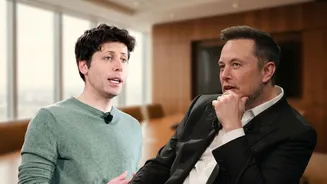
Musk described a pivotal moment in late 2022 when he learned of Microsoft's $10 billion investment in OpenAI. He characterized this development, conveyed to him by Sam Altman, as a 'bait and switch,' expressing his unease in a text message. Altman's subsequent offer for Musk to acquire stock in OpenAI was perceived by Musk as 'frankly, it felt like a bribe.' This interaction further solidified Musk's view that OpenAI's trajectory had deviated from its original non-profit ethos, leading to complex legal challenges concerning its future direction and financial structure.
Personal AI Ventures
When questioned about his company xAI utilizing OpenAI's technology for training, Musk defended the practice as standard industry procedure for validating AI models. He also addressed why his own AI company was not structured as a charity, testifying that for-profit entities can indeed deliver societal benefits. This explanation aimed to reconcile his critique of OpenAI's commercialization with his own business practices, suggesting that the intention behind a company's structure, rather than its for-profit status alone, determines its potential social impact.
Existential Risks and Testimony
The courtroom exchanges between Musk and OpenAI's legal team were notably tense, with Musk accusing the defense attorney of employing leading and tricky questions. This friction highlighted Musk's passionate advocacy for his position and his concerns about AI's potential existential risks. His legal team's attempt to introduce expert testimony on AI extinction risk, initially opposed by OpenAI, underscored the gravity with which Musk views these dangers, stating, 'We could all die.' The judge's observation about the irony of Musk developing AI amidst these concerns added another layer to the legal proceedings.