


Rooted Elegance Defined
In a fashion landscape often dominated by global trends and Western silhouettes, Mrunal Thakur stands out by embracing her cultural heritage. Her recent
choice of a meticulously embroidered black blouse exemplifies a sophisticated approach to dressing that is both confident and understated. This garment, rich with intricate hand-done craftsmanship, doesn't shout for attention but rather captivates with its subtle artistry. Paired with flowing drapes that allow the fabric to express its inherent beauty, the ensemble deliberately sidesteps the pressure of adhering to current fads, existing in a realm of timeless style. This highlights the profound power found in traditional Indian dressing, a style that doesn't merely keep pace with the present but endures far beyond it, offering a distinct and impactful aesthetic.
The Aura of Authenticity
Mrunal Thakur's comfort and genuine love for her chosen attire are palpable, radiating an effortless grace that enhances her look. There's a particular kind of self-assurance that emerges from wearing garments deeply connected to heritage, craft, and cultural lineage. This authenticity is not something that can be replicated through styling alone; it resonates powerfully and authentically on camera. The fashion industry, by its very nature, is characterized by cycles of change, where styles that are cutting-edge today can become obsolete within a short period. This constant flux is integral to the industry's momentum. However, genuine traditional Indian fashion, firmly grounded in artisanal skills and a continuous cultural narrative, operates outside this ephemeral cycle.
Enduring Craftsmanship's Triumph
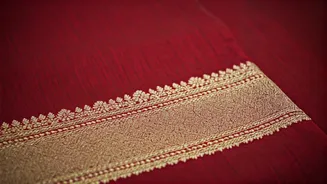
The enduring appeal of traditional Indian textiles and crafts is undeniable. A Banarasi weave, for instance, possesses the same breathtaking quality today as it did a century ago. Similarly, Chikankari embroidery has withstood the test of time, transcending epochs of empires, political partitions, and the advent of rapid fashion consumption. The art of Zardozi continues to gleam with the same opulence it displayed in the royal Mughal workshops. These are not ephemeral trends susceptible to the passage of time; they are enduring statements of artistry and cultural continuity. Their permanence is precisely what gives them a consistent advantage, commanding attention and admiration whenever a woman chooses to adorn herself in authentic traditional attire, often creating a moment of hushed appreciation.
A Sense of Belonging
Beyond its aesthetic and historical significance, there is a deeply personal dimension to traditional Indian fashion for women from the subcontinent. While Western clothing offers its own beauty, it often represents styles that have been culturally adopted. In contrast, traditional Indian attire serves as a profound homecoming for Indian women, fitting them in a way that feels intrinsically right. It carries a different narrative, photographs distinctively, and ultimately, allows the wearer to appear completely at ease and authentically herself. This visual harmony stems from a genuine connection to the clothing, signifying a belonging that is both evident and deeply felt, creating a powerful statement of identity.