




Sci-Fi's Instant Travel
The allure of instantaneous travel, a staple of science fiction, captivates our imagination, promising effortless journeys to distant locales. Recent anecdotal
claims, like that of an official reportedly teleporting to a Waffle House, have reignited public interest, though the individual clarified their experience might be better described as 'translated' or 'transported' in a spiritual context, especially given their concurrent cancer treatment. This brings us to the core question: is such rapid transit scientifically achievable, or does it remain a fantasy?
Quantum's Tiny Leaps
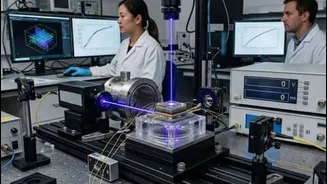
While teleporting humans is currently beyond our grasp, the fundamental principles of teleportation are indeed scientifically validated on a subatomic scale. Quantum teleportation, a groundbreaking technique, enables physicists to transfer the quantum state of one particle to another distant particle. This process has even led to the creation of imperfect particle copies, a phenomenon termed 'quantum telecloning.' The foundation of quantum teleportation lies in 'quantum entanglement,' a peculiar connection where two particles are intrinsically linked, sharing an existence. Measuring one instantaneously reveals information about the other, irrespective of the distance separating them – a concept Albert Einstein famously dubbed 'spooky action at a distance.' This entanglement acts as a conduit, allowing the physical state of one particle to be imprinted onto its entangled counterpart, effectively achieving a form of teleportation.
Milestones in Quantum
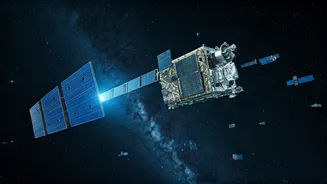
The theoretical groundwork for quantum teleportation was laid in 1993, followed by the first experimental demonstration between photons in 1997 by Austrian physicists. Subsequent years saw further advancements: in 2002, Australian researchers teleported the quantum state of a laser beam, and by 2006, Danish scientists successfully transmitted information within a laser beam to atoms over a foot away. The University of Science and Technology of China achieved particle teleportation over significant distances in 2012, and by 2017, Chinese satellites facilitated intercontinental quantum teleportation between space and Earth. More recent developments include the potential for teleporting electrons by 2020 and, in 2025, the successful transmission of information between protons using remotely created light sources via quantum dots. These breakthroughs are pivotal for secure quantum computing and communication.
Human Teleportation Hurdles
Replicating a single subatomic particle is a universe away from recreating an entire human being, composed of trillions of atoms. The energy and control required for such a feat are astronomical. Beyond the technical challenges lie profound philosophical and ethical dilemmas. If every atom in a person were deconstructed and reassembled elsewhere, would the original cease to exist, replaced by a mere replica? This raises serious questions about identity, consciousness, and the very definition of life, potentially equating teleportation with death and subsequent resurrection. Furthermore, the possibility of manipulating or enhancing the 'copy' introduces complex ethical considerations regarding human modification. Even a minor error in teleportation, like a particle misplacing itself, could lead to fatal or irreversible damage, making the everyday journey to a Waffle House seem surprisingly appealing.
Across Faith and Fiction
The human fascination with instantaneous travel predates science fiction, appearing in various religious and spiritual traditions. Ancient Indian texts like the Vedas and Yoga Sutras describe 'siddhis,' supernatural abilities including spontaneous transport, attained through spiritual discipline. Similar concepts are found in Jewish and Islamic scriptures, and the Bible recounts instances that can be interpreted as teleportation. In modern popular culture, the concept is a cornerstone of iconic franchises like Star Trek, though the famous phrase 'beam me up, Scotty' never actually appeared in the show. These narratives reflect a deep-seated human desire to transcend physical limitations. Yet, as the Waffle House incident suggests, sometimes seemingly miraculous events have more grounded explanations, like the possibility of having had a few too many drinks and ending up in an unexpected, yet familiar, breakfast diner.