




The Dawn of Robotic Tennis
The notion of a sophisticated robot stepping onto a professional tennis court to face off against a human champion, once relegated to speculative fiction,
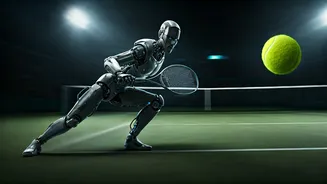
is rapidly becoming an achievable prospect. This evolution is largely credited to a significant advancement spearheaded by Galbot and its groundbreaking LATENT innovation. Historically, the pinnacle of robot athletics involved either remote operation or rigidly scripted sequences of actions, making unpredictable, real-time competition, especially against a dynamic human opponent, a formidable, if not insurmountable, challenge. However, Galbot and its research cohort have successfully navigated this complexity by employing minimal learning techniques to train a Unitree robot, specifically designed to engage in tennis rallies against an unpredictable human adversary. This marks a pivotal moment where robotic capabilities are transitioning from pre-defined tasks to adaptive, competitive engagement.
LATENT: Intelligent Motion Learning
The core of this revolutionary development lies in the LATENT (Learning Athletic Humanoid Tennis Skills from Imperfect Human Motion Data) system. Instead of embarking on the arduous task of training robots with an exhaustive repertoire of every conceivable human tennis skill, LATENT adopts a more strategic approach. It concentrates on dissecting tennis play into fundamental 'motion fragments' that encapsulate the primitive skills essential for the sport. The researchers have ingeniously devised a method to utilize these foundational building blocks, or 'imperfect' data, to provide the robot with sufficient insight into the basic human techniques employed in tennis scenarios. This focused learning allows the Unitree G1 robot to interpret live gameplay effectively and, as the developers attest, to consistently connect with incoming balls across a broad spectrum of conditions and return them to designated target areas with remarkable accuracy.
Real-World Performance Unveiled
The efficacy of the LATENT system is vividly demonstrated in a compelling video showcasing a Unitree G1 robot not just participating, but actively competing with and occasionally surpassing a human tennis player. This isn't merely a simulation; the researchers' publication highlights that their method yields surprising real-world results and facilitates stable, multi-shot rallies with human opponents. While one might speculate that the human player is either being lenient or strategically directing shots towards the robot, the robot's consistent returns and deliberate placement of the ball suggest a genuine competitive drive. The unit's ability to execute volleys and strategically position shots, often forcing the human player to react, presents a picture of burgeoning rivalry. This advanced performance, encompassing accurate ball returns, powerful backhands, agile footwork, and impressive stability, truly showcases the potential of the Galbot/LATENT collaboration.
The Future of Robot Athletes
Despite its current capabilities, the robot's performance, which can appear precarious at times with its racket seemingly integrated with its arm, indicates there's ample room for enhancement. Questions remain about its ability to handle shots significantly above its head. Nevertheless, the current iteration of the Galbot/LATENT robot delivers a captivating display of athletic prowess in tennis. This achievement is a significant precursor to what lies ahead. With continued development and refinement, it is not a stretch to envision robots of this caliber engaging in exhibition matches against renowned human athletes like Rafael Nadal. The transition from theoretical possibility to observable reality in robotics and artificial intelligence is accelerating, promising a future where the lines between human and machine competition blur in unprecedented ways.