




Firewood's Unwavering Role
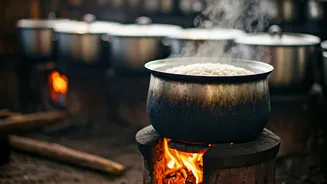
In the vast majority of government schools across Odisha, the Mid-Day Meal (MDM) program continues to rely on firewood for cooking. This traditional method
is employed in nearly 98% of the state's 48,514 government schools, catering to over 43 lakh students from early childhood education to Class X. While environmental considerations are often raised, the current energy crisis has underscored firewood's crucial role in ensuring the uninterrupted supply of meals. Schools typically maintain a stock of firewood sufficient for three to four months, providing a buffer against immediate supply chain disruptions. This reliance on firewood, though sometimes criticized, has proven to be a vital safety net, shielding the program from the volatile LPG market. The cost allocation for fuel within the MDM budget, set at Rs 11.15 per primary student and Rs 14.74 per upper primary student for material costs, includes a specific allowance for fuel, with 76 paise allocated per primary student and Re 1 per upper primary student for this purpose. This established financial framework further solidifies the practical implementation of firewood-based cooking within the school system, making it a sustainable and accessible option.
Innovative Steam Cooking
Beyond traditional methods, innovative cooking technologies are also playing a significant role in maintaining meal service continuity. The Akshaya Patra Foundation, for instance, utilizes a sophisticated steam-based cooking system in its centralized kitchens to prepare MDM for approximately 2.5 lakh students across five districts: Cuttack, Khurda, Sundargarh, Puri, and Nayagarh. This method involves burning briquettes, which are compressed blocks made from agricultural by-products like husk, to power steam boilers. The generated steam is then used for cooking staples like rice, dal, and dalma, with LPG reserved only for the final tempering stage. This approach not only reduces the dependence on LPG but also enhances operational efficiency and hygiene standards. The same efficient steam cooking model is also supporting the government's Aahaar initiative, which provides affordable cooked meals to urban populations. Across five districts, the foundation supplies 30,000 Aahaar meals daily, with a substantial portion of 20,000 meals served in Cuttack and Bhubaneswar alone. While initial LPG shortages affected centralized kitchens when commercial supplies were halted, subsequent regulation by district administrations helped mitigate the issue. Officials from the state urban development agency and the school and mass education department acknowledge that these alternative cooking arrangements have been instrumental in ensuring the consistent delivery of essential food services, particularly to vulnerable communities.