






Boston's Old World Charm
Boston, Massachusetts, offers a palpable European ambiance, harkening back to its founding in 1630 by English immigrants. The city's early architecture,
particularly in the Beacon Hill neighborhood, mirrors that of London with its narrow, picturesque streets, Federal-style row houses, ornate doorways, and gas lamps, especially around Louisburg Square. As the city evolved, other immigrant groups added to its international feel. Back Bay's Commonwealth Avenue evokes Parisian boulevards, while the North End, affectionately known as "Little Italy," immerses visitors in Italian culture with its historic streets brimming with old-world cafes, pasta restaurants, pastry shops, and vibrant summer festivals. The meandering, seemingly illogical street layouts in older parts of downtown Boston add to its undeniable, charming European character, inviting leisurely exploration.
Michigan's Little Bavaria
Frankenmuth, Michigan, transports visitors to a Bavarian alpine setting, a surprising contrast to its Midwestern locale. Established in 1845 by German missionaries, the town, affectionately known as 'Michigan's Little Bavaria,' proudly retains its German heritage. Guests can hear German spoken, experience cultural traditions, and admire architecture that pays homage to Bavaria, including onion domes, red roofs, and carved wooden shutters. Even commercial buildings often reflect traditional German design. Replicas of famous city towers from Rothenberg and Gunzenhausen, along with an Austrian 'Silent Night' chapel, further enhance the immersive experience. Culinary delights abound, with establishments serving authentic German fare like wiener schnitzel, sauerbraten, and spaetzle, often prepared by staff in traditional attire. Family-style chicken dinners, a long-standing local tradition since the late 1800s, are also a must-try.
Colorado's Alpine Village
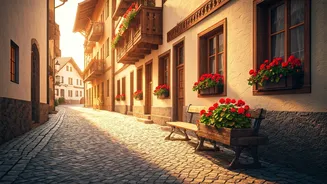
Vail, Colorado, captures the spirit of European alpine resorts, drawing inspiration from Austrian and Swiss mountain towns like Kitzbuehl and Zermatt. Developed in the early 1960s, Vail was designed with a pedestrian-friendly, car-free village center that mirrors the layout and energy of its European counterparts. The town's architecture, featuring cream stucco walls, arched red roofs, and flower-lined balconies, evokes the charm of historic European inns. Visitors can indulge in authentic Swiss cuisine, such as warm, comforting fondue and decadent raclette, at restaurants that feel like they've been transported from the Alps. Additionally, shops offer apparel and goods from Germany, Austria, and Italy, further solidifying Vail's European atmosphere amidst its stunning mountain backdrop.
Florida's Spanish Roots
St. Augustine, Florida, the oldest continuously occupied European settlement in the U.S. founded in 1565, offers a journey back in time with its distinctly European character. Its historic courtyards, ornate facades, centuries-old landmarks, and walled gardens create an atmosphere reminiscent of the Mediterranean. Pedestrian-friendly streets encourage exploration, making visitors feel as if they've stepped onto European soil. Accommodations often feature European architectural styles, like Moorish Revival, complete with arched courtyards. The culinary scene pays homage to its Spanish heritage, offering authentic tapas and Minorcan specialties, alongside traditional Spanish and Cuban dishes at award-winning restaurants. Key historical sites include the 17th-century Spanish fortress Castillo de San Marcos and Avilés Street, one of the oldest streets, which evokes the feeling of navigating a narrow European alley.
Texas Hill Country Gem
Fredericksburg, Texas, nestled in the Hill Country, offers a surprising immersion into German culture, a legacy of its founding in 1846 by German settlers. This strong German community, with families tracing their lineage back seven generations, has preserved traditions and a distinct way of life. The historic Main Street, intentionally free of chain stores, maintains a unique character, boasting a thriving wine industry and over 120 restaurants, many of which serve authentic German cuisine like wiener schnitzel and bratwurst. Local eateries and breweries offer traditional German flavors and beverages. October is a particularly festive time, with Oktoberfest celebrations filling the town square with polka music, activities, and German beer. Visitors can also experience history firsthand by staying in a 'Sunday House,' historic small homes once used by ranchers traveling to town for Sunday services.
California's Danish Village
Solvang, California, situated among the vineyards of the central coast, stands as a remarkably authentic Danish village, founded in 1911 by Danish-American educators. Over a century later, its name, meaning 'sunny field,' perfectly describes its vibrant atmosphere. Visitors are greeted by Danish architecture, including traditional half-timbered buildings with thatched roofs and numerous wooden windmills. The village boasts several museums and exact replicas of famous Danish landmarks, such as Copenhagen's Rundetårn tower and the 'Little Mermaid' statue, allowing for an immersive cultural experience. Sweet treats are a highlight, with bakeries offering Danish pastries like kringle, butter cookies, strudel, and flodeboller. For a hearty meal, restaurants serve Danish specialties, reflecting the town's heritage in a walkable, charming setting.