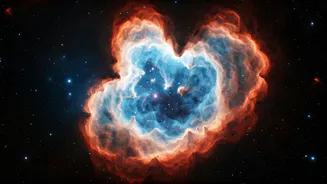

A Cosmic Nursery
The Large Magellanic Cloud (LMC), a dwarf galaxy orbiting the Milky Way, serves as a bustling stellar nursery, offering astronomers a front-row seat to
star formation. The Hubble Space Telescope has been instrumental in observing this process, providing unprecedented detail. Its high-resolution capabilities allow scientists to study young stars within the LMC with remarkable clarity, revealing intricate structures and processes that were previously hidden. These observations provide crucial data for understanding the lifecycle of stars, including their formation, evolution, and eventual demise. The LMC's relatively close proximity makes it an ideal location for detailed astronomical studies, allowing astronomers to glean valuable insights into the formation of stars in diverse environments and their impact on the surrounding galactic landscape.
Hubble's Keen Eye
The Hubble Space Telescope, renowned for its exceptional optics and longevity, has spent decades capturing the universe's wonders. Its ability to resolve fine details allows for the study of the LMC's star-forming regions with unprecedented precision. The images captured by Hubble show stellar nurseries as dynamic, evolving environments, with young stars actively shaping their surroundings. These observations demonstrate how gas and dust clouds collapse under gravity, igniting nuclear fusion and giving birth to new stars. Hubble's instruments can analyze the light emitted by these stars, providing information about their composition, temperature, and movement. This data helps astronomers understand how stars interact with their environments, influencing the evolution of galaxies and the availability of elements essential for the creation of planets and, potentially, life.
Star Formation Insights
The Hubble's observations of the LMC have provided crucial insights into the star formation process. By studying the light from these young stars, astronomers can determine the ages, masses, and compositions of these celestial objects. This enables them to reconstruct the events that led to their formation. The detailed images also reveal the presence of protoplanetary disks, swirling clouds of gas and dust that surround young stars, where planets are believed to form. The Hubble telescope helps track these disks' evolution. Observations of the LMC also help in the understanding of the roles played by massive stars and supernova explosions. These massive stars emit high-energy radiation and strong stellar winds, affecting the surrounding material, shaping star-forming regions, and even triggering the formation of new stars.
Beyond the Visible
While Hubble primarily captures visible light, it also has instruments sensitive to other wavelengths of the electromagnetic spectrum. This allows it to study various phenomena that are hidden from our view. By observing in ultraviolet and near-infrared light, for example, Hubble can penetrate through the dense clouds of dust that obscure star-forming regions. This ability is crucial for mapping out the internal structure of these nurseries and understanding how stars form within them. The data collected provides comprehensive information about the composition, density, and temperature of interstellar gas and dust. Analysis of these wavelengths also helps astronomers uncover the presence of complex molecules. These explorations can offer further insights into the processes occurring within star-forming regions and their broader impact on the galactic environment.
Future Discoveries
The Hubble Space Telescope continues to advance our knowledge of the universe, and its observations of the LMC are crucial in understanding stellar formation. Astronomers will use these existing images and data to refine their models of star formation, and investigate how it varies in different parts of the LMC. Future missions, such as the James Webb Space Telescope (JWST), build upon Hubble's success. JWST, with its advanced infrared capabilities, promises to reveal even more details within star-forming regions, penetrating the dust clouds and allowing for a clearer view of the young stars and their surroundings. The insights derived from Hubble's past and future missions will continue to shape our understanding of the universe, and will help in exploring its origins. The detailed observations give astronomers more information, which also leads to further studies of galactic evolution.