







Coastal Advantages
The contrasting landing approaches of American and Russian space programs are largely dictated by their unique geographical advantages. The United States
benefits from extensive coastlines along both the Atlantic and Pacific Oceans, providing vast bodies of water ideal for spacecraft recovery. This accessibility, coupled with a robust naval presence in international waters, allows NASA to safely retrieve its returning capsules. Russia, while possessing a much longer coastline, primarily borders the Arctic Ocean. This region presents significant challenges for crewed spacecraft recovery due to harsh conditions and limited logistical support. Consequently, Russia has historically relied on its vast, sparsely populated landmass for landings, a strategy enabled by its launch site in land-locked Kazakhstan, the Baikonur Cosmodrome.
Shock Absorption Dynamics
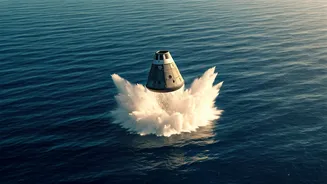
Water plays a crucial role in softening the impact for American spacecraft. While both U.S. and Russian missions utilize parachutes to reduce descent velocity, the methods diverge significantly upon nearing the surface. Soyuz spacecraft, designed for terrestrial landings, employ retrorockets firing moments before touchdown. These engines counteract the downward momentum, slowing the craft to less than five feet per second for a relatively gentle ground impact. In stark contrast, American spacecraft, like those returning from the ISS, are engineered to hit the water at approximately 80 feet per second. The immense body of water acts as a massive shock absorber, dissipating the force of the impact. This difference is so pronounced that returning Soyuz cosmonauts have described their landings as akin to a severe collision, whereas astronauts on Artemis II found their moon landing exhilarating, comparing it to a thrilling roller coaster ride.
Historical Landing Evolution
The practice of splashdowns for American crewed and uncrewed missions dates back to 1961, with the ocean serving as a reliable landing zone for returning capsules. NASA collaborates closely with the U.S. military to ensure efficient recovery operations, retrieving both the spacecraft and its occupants from the water and bringing them safely back to shore. This consistent approach underscores the strategic use of maritime resources. Russia's history with water landings is notably limited; their Soyuz spacecraft are primarily designed for land touchdowns. A solitary instance of a crewed Russian mission ending in a water landing occurred in 1976 with Soyuz 23. This event was unintentional and proved perilous, with the two cosmonauts stranded in a partially frozen lake for approximately nine hours, highlighting the inherent risks associated with unintended splashdowns for craft not designed for such landings.