

Understanding Aurora Triggers
The captivating dance of the aurora borealis is a direct consequence of energetic particles from the sun interacting with Earth's atmosphere. These solar
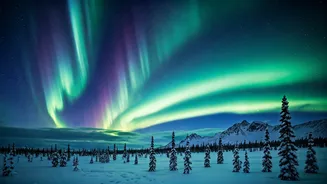
particles, primarily ejected during solar flares and coronal mass ejections (CMEs), travel through space and, when they reach our planet, collide with atmospheric gases. This collision excites the gas atoms, causing them to emit light, which we perceive as the vibrant colors of the aurora. Geomagnetic storms, measured by the Kp-index, play a crucial role; higher Kp values indicate more intense storms and a greater likelihood of auroras being visible over wider geographical areas. Fast solar wind streams, originating from coronal holes on the sun's surface, also contribute significantly by consistently bombarding Earth with charged particles. When these elements align favorably, such as an Earth-directed CME or a persistent fast solar wind, the stage is set for spectacular auroral displays, often extending visibility to mid-latitudes, not just the usual high-latitude regions.
Forecasting Aurora Displays
Predicting aurora sightings involves monitoring various solar phenomena and their potential impact on Earth's magnetosphere. Space weather forecasts often highlight the arrival of CMEs or the presence of fast solar wind streams, which are key drivers of geomagnetic activity. Reports frequently mention moderate to strong geomagnetic storm conditions, with Kp levels reaching G1, G2, or even G3, indicating a good chance for auroras. Alerts are often issued when these events are anticipated, such as "CME incoming!" or "Fast solar wind could spark auroras." These forecasts also specify the expected visibility range, noting whether auroras will be confined to high latitudes or potentially visible in mid-latitude areas, sometimes even mentioning specific regions like New York or Illinois. The timing of these events is also critical, with forecasts often looking ahead to the weekend or specific dates for potential aurora shows, advising observers to keep their eyes on the skies.
When to Watch
The optimal times for viewing the aurora borealis are generally during periods of heightened solar activity and geomagnetic storms. Announcements frequently point to specific dates and even weekends when conditions are expected to be favorable. For instance, a "strong geomagnetic storm alert" or the "arrival of a CME" often signals prime viewing opportunities. Forecasts commonly indicate "good chances of northern lights" when geomagnetic activity is elevated or fast solar winds are prevalent. These alerts might specify that auroras are possible "tonight and tomorrow" or that "conditions could improve by the weekend." Observers are often advised to check forecasts for upcoming CME arrivals or the approach of coronal holes, as these events are strong indicators of potential aurora displays. Even during quieter periods, occasional "minor geomagnetic storms" can still offer chances to see the lights, particularly at higher latitudes.
Factors Affecting Visibility
Several factors influence the visibility of the aurora borealis beyond just solar activity. Geomagnetic storm strength, often categorized by Kp levels (e.g., G1 for minor storms, G3 for strong storms, and even G4 for severe storms), directly correlates with how far south auroras can be seen. A more intense storm means a wider potential viewing area. The presence of fast solar wind streams, originating from coronal holes, can also sustain or enhance aurora activity. Conversely, periods of "quiet geomagnetic activity" or "waning solar winds" tend to confine the aurora to higher latitudes, making it less likely to be seen in more populated mid-latitude regions. Additionally, local weather conditions play a significant role; clear, dark skies are essential for optimal viewing. Light pollution from urban areas can also obscure fainter auroral displays, making remote locations with minimal light interference ideal for aurora chasing.