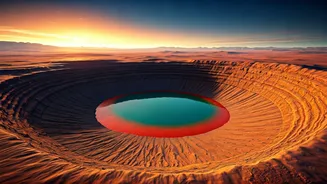









A Celestial Collision
Fifty millennia ago, an extraordinary celestial event reshaped India's Deccan Plateau. A colossal meteorite, weighing a staggering two million tons and
hurtling through space at incredible velocity, struck the Earth's surface. This cataclysmic impact tore through the ancient basaltic rock, carving out a profound depression that would eventually become Lonar Lake. This cosmic intervention left an indelible mark, a testament to the universe's power to sculpt our planet. The resulting crater, nestled in the heart of Maharashtra, serves as a remarkable geological time capsule, its formation in hard basalt mirroring the very composition of the Martian surface, earning it the evocative title of Earth's 'twin' to the Red Planet. This unique characteristic makes Lonar an invaluable site for scientific research, allowing NASA scientists to study potential ancient Martian environments where water may have once existed, essentially bringing a piece of Mars to our own backyard.
Dual Waters Mystery
Descending into the Lonar crater feels like entering another realm. As you venture down its steep, jungle-clad walls, the sounds of the modern world fade, replaced by an almost prehistoric atmosphere. The environment within the crater possesses a unique duality. Most astonishingly, the lake itself is divided into two distinct sections of water that do not readily mix. One portion is notably alkaline, while the other is distinctly saline. This peculiar chemical dichotomy has puzzled scientists for years, presenting an ongoing mystery of nature. This dual-natured body of water, simultaneously salty and fresh, embodies the ancient yet vibrant character of Lonar, a place where natural forces create astonishing contradictions and scientific intrigue.
Pink Transformation
Lonar Lake is not merely a static geological feature; it is a dynamic and surprising ecosystem. In a remarkable display in 2020, the lake's waters underwent a breathtaking metamorphosis, turning a vivid, glowing pink. This astounding transformation was not a cause for alarm, but rather a celebration of life. It was attributed to the proliferation of rare microorganisms known as Haloarchaea. A surge in the lake's salinity levels provided the perfect conditions for these microbes, prompting them to release pigments that dramatically altered the water's hue from its usual emerald green to a stunning rose. This event served as a powerful reminder that Lonar is a living, evolving entity, capable of revealing astonishing beauty and continuing to surprise observers with its biological dynamism.
Echoes of the Past
Dotting the circumference of Lonar Lake are the remnants of ancient history: the 'Ghost Temples'. These exquisite Hemadpanti ruins, dating back to the 12th century, stand as silent witnesses to bygone eras. Over time, the encroaching silt and tenacious roots of the surrounding vegetation have begun to subtly reclaim these stone structures. A profound sense of stillness pervades these hallowed grounds. While these temples have endured for nearly a millennium, within the vast geological timescale of the crater's existence, they represent a comparatively recent chapter. They serve as poignant reminders that even as human civilizations and empires rise and inevitably fall, the enduring presence of the Lonar crater persists, a constant in the landscape.
Cosmic Souvenirs
The very ground beneath your feet at Lonar tells a profound story of cosmic power and transformation. The geological materials found here are direct souvenirs from the immense impact event. You might discover 'maskelynite', a glassy substance formed under the intense heat and pressure of the meteorite's collision, or encounter magnetic fragments that playfully disorient compass needles. These elements make Lonar a spiritually significant location for those fascinated by space and geology. Every rock and particle is a tangible link to the moment our planet was irrevocably altered by an extraterrestrial visitor, allowing for a unique connection to the prehistoric forces that shaped the Earth.
Perspective on Time
As twilight descends and the sun dips below the crater's rim, casting long, dramatic shadows across the water, one gains a profound perspective on time. Lonar Lake transcends its status as a mere tourist destination or a scientific anomaly; it functions as a powerful humbling force. For an astonishing 50,000 years, this crater has silently observed the closing chapters of the Ice Age, the rise and fall of countless human civilizations, and the ceaseless dance of the stars. Standing here feels like being positioned at a cosmic crossroads, a place where terrestrial and extraterrestrial histories converge, reinforcing the understanding that we inhabit a planet continuously shaped by the vast and dynamic cosmos.