






Orbital Insertion Failure
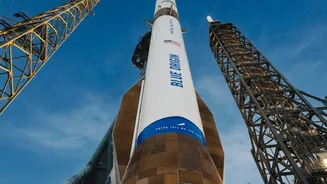
In a notable turn of events, Blue Origin's much-anticipated New Glenn rocket mission encountered a critical flaw, failing to achieve its primary objective
of delivering a satellite for AST SpaceMobile into the correct orbit. The launch, which departed from Cape Canaveral, Florida, on Sunday morning, initially showed promise with the successful re-flight of a New Glenn booster, a testament to the program's reusability goals. However, approximately two hours post-liftoff, Blue Origin disclosed that the satellite, named BlueBird 7, had been placed into an orbit significantly lower than planned. This suboptimal altitude renders the satellite incapable of sustained operations, necessitating its de-orbit and eventual burn-up in Earth's atmosphere. While AST SpaceMobile has confirmed the satellite is insured and has a pipeline of replacement satellites set for launch within a month, and holds contracts with other launch providers for future deployments, this marks the first substantial mission failure for the New Glenn program, which has been in development for over a decade and only had its inaugural flight in January 2025. This mission was the second carrying a commercial payload, following a previous launch of NASA spacecraft bound for Mars in November.
Programmatic and Strategic Implications
This deviation from mission success carries considerable weight for Blue Origin's broader strategic aspirations, particularly its bid to become a key player in NASA's lunar exploration initiatives, such as the Artemis program. The space agency, alongside governmental influences, has been pressing for the rapid development of lunar landers by both Blue Origin and SpaceX, with the goal of establishing a lunar presence before advancing to crewed missions. Blue Origin's CEO has publicly committed to prioritizing efforts to accelerate NASA's return to the Moon. The company has also been progressing with testing its own uncrewed lunar lander, with plans for a potential launch later this year. There was an earlier consideration to utilize the third New Glenn mission for this lander's deployment, but this plan was ultimately altered. The repercussions of this orbital failure could ripple through these ambitious timelines and potentially affect confidence in the New Glenn platform's reliability for critical governmental and commercial payloads going forward.
Booster Reuse Success Amidst Failure
The launch itself featured a significant milestone: the successful re-flight and recovery of a New Glenn booster. This specific booster had previously flown on New Glenn's second mission. Roughly ten minutes after its ascent, the booster executed a controlled descent and landed precisely on a drone ship positioned in the ocean, mirroring its performance from the November flight. The reusable booster's successful landing was even acknowledged by Jeff Bezos on social media. This demonstration of booster reusability is a crucial element of Blue Origin's strategy to reduce launch costs and increase flight cadence. In contrast to the current setback, SpaceX, while also undergoing extensive testing with its Starship vehicle, has historically used inert payloads during its developmental flights to refine its rockets. However, SpaceX has faced its own payload losses earlier in its Falcon 9 program, including a cargo spacecraft destruction in 2015 and an on-pad explosion in 2016 that destroyed an internet satellite.