




A Cosmic Collision
In a pioneering display of planetary defense, NASA's Double Asteroid Redirection Test (DART) mission achieved an unprecedented feat: intentionally altering
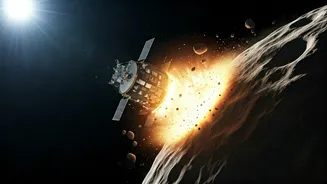
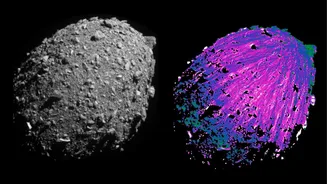
the orbital path of an asteroid. This historic event, which took place on September 26, 2022, at 7:14 p.m. EDT, marked the first time humanity has ever succeeded in changing the trajectory of a celestial object. The target was Dimorphos, a small asteroid that orbits a larger companion, Didymos. The DART spacecraft, a robust vehicle weighing approximately 1,210 pounds (550 kilograms), was purposefully aimed at Dimorphos, striking it at an astonishing speed of about 14,700 miles per hour (23,600 kilometers per hour). The impact was a carefully orchestrated maneuver designed to test the kinetic impactor technique, a method that relies on the sheer force of a collision to redirect a potentially hazardous asteroid.
Measuring the Shift
The success of the DART mission, and specifically its ability to change Dimorphos' orbital behavior, was confirmed through meticulous observations from telescopes situated across the globe. These ground-based instruments were tasked with precisely measuring the subtle yet significant shift in Dimorphos' orbit around Didymos. This alteration in its celestial dance around its larger partner is the crucial evidence that the mission's objective was met. The data gathered from these observations provides irrefutable proof of the kinetic impact technology's effectiveness. This successful demonstration is more than just a scientific curiosity; it represents a vital leap forward in our ongoing efforts to develop practical and reliable strategies for safeguarding our planet from the existential threat posed by potential asteroid impacts.
Future Defense Strategies
The profound insights gained from the DART mission are poised to play an indispensable role in shaping future planetary defense initiatives. By successfully proving that a spacecraft's kinetic energy can be harnessed to alter an asteroid's course, NASA has laid a critical foundation for developing a robust asteroid deflection system. The detailed analysis of the impact's consequences, including the precise change in Dimorphos' orbital period, offers invaluable data for refining models and simulations. This empirical evidence will empower scientists and engineers to design more effective missions for mitigating future asteroid threats. In essence, DART has transitioned planetary defense from a theoretical concept to a tangible capability, offering humanity a more secure future against cosmic dangers.