




Lunar Gold Rush Begins
A new era of lunar resource exploration is dawning, spearheaded by a visionary startup aiming to harness the Moon's potential. This venture is significantly
boosted by a substantial $6.9 million contract from NASA. This funding, provided through the Space Technology Mission Directorate's Game Changing Development program, is earmarked for the creation of a sophisticated payload. This payload will be integral to an upcoming lunar lander mission, specifically designed to pioneer methods for extracting valuable isotopes like helium-3 directly from the lunar soil, known as regolith. This innovative approach promises to be the very first instance of in-situ extraction of solar wind-implanted volatiles from the Moon's surface, a monumental achievement for space exploration and resource utilization.
Prospect Moon's Ingenuity
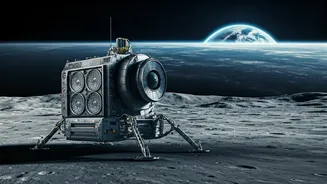
The heart of this lunar extraction endeavor is a cutting-edge payload named Prospect Moon. This advanced system incorporates a robotic arm, meticulously engineered to gather samples of lunar regolith. Once collected, these samples undergo rigorous analysis within an instrument designed for precise measurements. A key process involves heating the regolith to identify and quantify volatile gases such as helium-3 and hydrogen that are released. Beyond gas analysis, the payload also features mechanical processing capabilities, enabling size sorting, agitation, and crushing of the regolith. These multifaceted operations are crucial for calibrating and refining the extraction techniques that will eventually be employed in larger-scale lunar resource operations, providing vital efficiency data for future development.
Roadmap to Extraction
The Prospect Moon payload is meticulously scheduled for integration onto a lunar lander by the autumn of 2027, with a planned launch in 2028. The company is actively evaluating multiple lander mission options, with a strategic preference for missions targeting the lunar equatorial regions. This strategic alignment capitalizes on NASA's ambitious plans for a surge in lander missions, including the development of a lunar base. The payload's relatively low construction cost allows for the production of multiple units, facilitating their deployment on various landers. This initiative directly supports NASA's overarching objectives for its Artemis program and the establishment of a lunar base, positioning the company as a key commercial partner for lunar infrastructure development.
Market Demand Signals
The pursuit of helium-3 is not merely a technological ambition; it is driven by significant market demand. The company has already secured substantial contracts from entities like the Department of Energy and leading quantum computing firms, Maybell Quantum and Bluefors, totaling approximately $500 million. These agreements serve as a strong indicator of a robust and growing market for helium-3. Furthermore, the company has received letters of intent for additional supplies, which are currently being converted into formal contracts. Some of these commitments necessitate the commencement of helium-3 deliveries as early as 2028, a timeline that precedes the company's full-scale lunar harvesting capabilities, prompting exploration of terrestrial sources as an interim solution.