






Funding Reusable Dreams
Lux Aeterna, a forward-thinking company based in Colorado, has successfully garnered $10 million in fresh investment to propel the creation of its entirely
reusable satellite technology. The company firmly believes this advancement will reshape the space industry, moving beyond the conventional "launch-and-dispose" model to embrace a more economical and capable approach for a wide array of uses, including large-scale production and defense operations. The company's vision, championed by its founder and CEO Brian Taylor, centers on establishing fleets of satellites capable of dependable Earth returns and rapid redeployments, thereby unlocking novel economic frameworks and mission possibilities that were previously out of reach. Taylor's prior involvement in significant projects like SpaceX's Starlink and Amazon's Project Kuiper underscores his understanding of the substantial, compounding cost benefits derived from reuse, drawing parallels to the success seen in reusable rocket technology which has already dramatically lowered launch expenditures. This new funding round, an oversubscribed seed investment led by Konvoy and supported by other firms, boosts Lux Aeterna's total raised capital to $14 million, following a $4 million pre-seed round the previous year.
Delphi: The Pathfinder
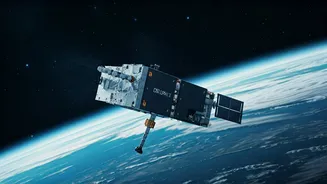
The newly acquired funds are earmarked for the design and manufacturing of Delphi, Lux Aeterna's pioneering prototype for a reusable satellite platform. This initial vehicle, measuring approximately 3.6 feet (1.1 meters) in width and weighing 440 pounds (200 kilograms), is scheduled for its inaugural flight in early 2027. It will hitch a ride on one of SpaceX's Transporter rideshare missions. While this maiden voyage is primarily intended to showcase the technology's capabilities, Delphi will also transport various payloads into orbit, and crucially, bring them back down to Earth. Although specific details about the payload manifest are not yet public, Lux Aeterna has indicated that it will comprise a diverse mix of civil defense and commercial clients participating in this pioneering mission. It's important to note that Delphi is conceptualized as a demonstrator and a precursor, not as a finalized production model. The company's future operational fleet will feature larger and more advanced satellite platforms, with subsequent iterations designed to fit atop existing rockets and, eventually, to be compatible with SpaceX's Starship megarocket.
Transforming Space Economics
The core philosophy driving Lux Aeterna is that the future of the space economy is intrinsically linked to the development of satellite fleets that can reliably return to Earth and be quickly relaunched. This paradigm shift promises to unlock entirely new economic models and application scenarios previously considered impractical or impossible. By eliminating the perpetual need to manufacture entirely new satellites for every mission, Lux Aeterna aims to achieve significant cost savings, mirroring the impact of reusable rocket technology. This reduction in manufacturing expenses and supply chain complexities is a key differentiator. Furthermore, the ability to reuse satellites grants customers unprecedented flexibility. Payload designers are no longer constrained by the typical operational lifespan of a satellite, which is often around five to seven years in low Earth orbit. Instead, missions can be conceptualized and centered around the payload itself, paving the way for innovative mission architectures. These include advancements in in-space manufacturing, streamlined cargo resupply operations, and specialized applications like hypersonic testing. While other entities are exploring related fields, Lux Aeterna distinguishes itself with its unwavering focus on complete satellite reusability, aiming to have tens of operational satellites by 2030 and hundreds by 2035.