








Spacetime's Gentle Tug
The concept of spacetime was initially introduced by Albert Einstein's theory of general relativity in 1915. Einstein proposed that mass warps the structure
of spacetime, which is a unified entity of space and time. The intensity of this distortion is directly proportional to an object's mass; the greater the mass, the more significant its gravitational influence. A groundbreaking concept arose in 1918 from Austrian physicists Josef Lense and Hans Thirring. Their application of general relativity led to the understanding that massive, spinning objects have the ability to drag spacetime along with them. This phenomenon, known as frame dragging or the Lense-Thirring precession, offers a novel lens through which scientists can investigate black holes.
Observing the Unseen
Although the principles of frame dragging have been understood for quite some time, direct observation of this effect has proven to be challenging for scientists. The recent advancements in technology and observational techniques are beginning to provide insights into this phenomenon. A team of astronomers has observed a star exhibiting a wobbling motion in its orbit, revolving around a supermassive black hole. This wobbling is a direct consequence of the Lense-Thirring effect, where the spinning black hole distorts the surrounding spacetime, thereby influencing the star's path. These observations have opened up new avenues for research, giving scientists a novel approach to study the behavior of black holes, how they consume matter, and the powerful outflows that they produce.
Black Holes at Work
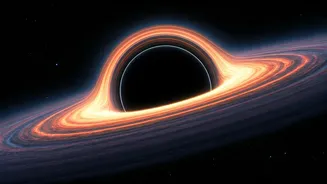
Scientists are using this novel research to study the spin of black holes. The spin rate provides information on the behavior of black holes. For example, a rapidly spinning black hole exhibits a more pronounced frame-dragging effect. The new research offers insights into how black holes feed on matter, a process known as accretion. When a star gets too close, the black hole tears it apart, and the resulting debris forms an accretion disk, which is gradually consumed. The researchers are studying these events to determine the rate at which matter is pulled in and how this influences the black hole's growth. They are studying how tidal disruption events (TDEs) generate powerful outflows, or jets. These jets emit immense energy, and understanding them could help scientists understand how black holes impact their surrounding galaxies.