







Artistic Expression Unveiled
A father's viral sharing of his child's peculiar drawing, depicting him joyfully plummeting from a roof while the family looked somber, sparked widespread
online conversation. This incident serves as a potent reminder for parents that seemingly unusual artistic details aren't always indicators of distress; rather, they often reflect a child's distinct perception of the world. Art specialists emphasize that young artists frequently weave together elements of reality, their emotional states, and flights of fantasy, rarely intending their work to signify alarm. Parents are encouraged to view these creative outputs as valuable opportunities for open-ended dialogue, using them as gateways to understanding their children's internal landscapes and feelings.
Interpreting the Sketch
The drawing in question featured a family gathered on a rooftop. While the figures were rendered with minimal detail, the emotional tenor was palpable. The father's representation was depicted mid-fall, or perhaps a leap, from the roof's edge, his face adorned with a broad smile. In contrast, the other family members were static, conveying a sense of solemnity. For adults, such imagery can evoke immediate concern, prompting a search for underlying issues like fear, anger, or distress. However, children's artistic processes don't always follow adult logical structures; their imagination freely merges the tangible world with their feelings and fanciful notions in ways adults often overlook.
The Essence of Child Art
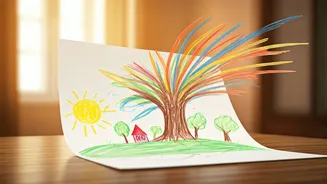
A child's drawing transcends a mere replication of observed reality; it is a rich tapestry woven from their feelings, memories, and imaginative constructs, often occurring simultaneously. For instance, a child might combine a real-life event, such as a parent's departure for work, with a feeling of missing that parent or a desire for attention, and then infuse it with a fantastical notion like flying or falling, akin to superhero feats. Consequently, a falling figure doesn't automatically signify peril; it could represent motion, transition, or even sheer excitement. The presence of a smile on the falling figure's face is particularly revealing, suggesting the child did not perceive the depicted moment as frightening.
Adult Misinterpretations
Adults tend to seek linear narratives in art, whereas children often produce snapshots of their emotional experiences. A parent might interpret a drawing of a falling figure as indicative of danger, while a child might simply be illustrating concepts like 'Dad sometimes leaves,' 'Dad is engaged in an adventurous activity,' or 'Dad is distinct from the rest of us in this particular scene.' Furthermore, children frequently embellish scenarios to enhance their dramatic effect, transforming a simple roof into a stage and a departure into an epic action. This disconnect arises because adults interpret through a lens of logic, while children create driven by emotion.
Art as Communication
A profound, understated truth revealed by such drawings is that children often communicate sentiments they are unable to articulate verbally. An artwork like the one described could reflect a child's awareness of absence or distance, a playful exploration of themes related to departure and return, or a healthy outlet for processing emotions in a secure, creative space. It's crucial to understand that while such drawings don't always convey serious issues, they also don't signify nothing at all. The true value lies in adopting a posture of curiosity rather than immediate reaction.
Parental Guidance
When a child's artwork evokes a sense of unease, the optimal approach for parents is neither panic nor dismissal, but rather a gentle pursuit of understanding. Instead of posing direct, potentially interrogative questions like, 'Why did you draw this?', consider framing prompts that encourage narrative and emotional exploration. For example, inviting the child to 'Tell me about what's happening here,' or 'What is everyone feeling in this picture?', or 'What happens next in the story?' Children are often more inclined to share their thoughts and feelings when they perceive a safe, non-judgmental environment. Sometimes, the explanations are remarkably straightforward; the 'falling' father might simply be 'going somewhere,' and his smile could signify excitement rather than dread.
Childhood's First Language
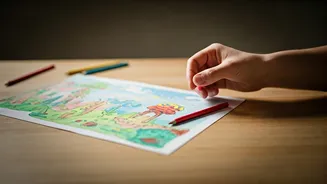
Long before children develop sophisticated verbal communication skills, drawing serves as their primary mode of expression. These early sketches function as invaluable records of their emotional lives, providing a sanctuary where they can experiment with ideas and concepts. Art becomes a fundamental way for them to connect with their parents, offering a bridge when precise language is not yet available. It is a fundamental language through which they process their world and their place within it.