






The Solar Ceiling
Harnessing the sun's energy through photovoltaic cells offers a clean power source, but a fundamental limitation, known as the Shockley-Queisser limit,
has capped its potential. First theorized in 1961, this limit dictates that only about 33 percent of incoming solar power can be converted into usable electricity. This is because sunlight encompasses a broad spectrum of light energy, and conventional semiconductor materials are only efficient at converting a narrow band of this spectrum. The remaining energy is either not absorbed or is lost as heat, presenting a significant barrier to maximizing solar panel performance. Most commercial solar panels currently operate well below this theoretical maximum, highlighting the ongoing challenge to improve their efficiency and make solar energy more potent.
A Novel Energy Harvest
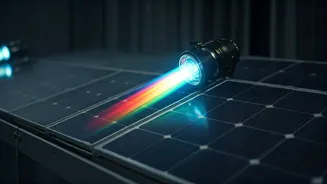
A remarkable new approach is challenging the long-standing Shockley-Queisser limit. Researchers from Japan and Germany have detailed a process in the Journal of the American Chemical Society that effectively captures portions of the light spectrum typically lost as waste heat. This innovative technique involves using high-energy blue light to interact with a specific compound. When exposed to this blue light, the compound can split the incoming energy into two usable forms, enabling an energy conversion efficiency of approximately 130 percent. This means that for every 100 units of light energy entering the system, the researchers were able to extract 130 units of usable energy carriers, a feat previously thought impossible under the existing theoretical framework.
The Chemistry Behind
The breakthrough hinges on a clever combination of an organic molecule called tetracene and the metallic element molybdenum. While tetracene has been previously explored for its ability to interact with high-energy blue light, practical limitations prevented sustained energy conversion. The key innovation lies in the addition of molybdenum, which researchers found resolved these previous issues, allowing for prolonged and effective energy harvesting. This synergistic combination allows the system to generate two excitons from a single photon, a process known as singlet fission, which is central to exceeding the conventional efficiency limit. This discovery represents a significant step forward in manipulating light energy for practical applications.
Future Prospects
While this achievement of 130 percent energy conversion efficiency is currently confined to controlled laboratory settings, it signifies a major breakthrough in solar energy research. It demonstrates a tangible path to overcoming a theoretical ceiling that has persisted for over six decades. In comparison, the most efficient commercially available solar panels today achieve around 23 percent efficiency, and substantial improvements in this area are not expected in the immediate future. Nevertheless, this experimental success offers a compelling glimpse into the potential for next-generation solar technologies that could dramatically increase energy yields and redefine the landscape of renewable energy.