





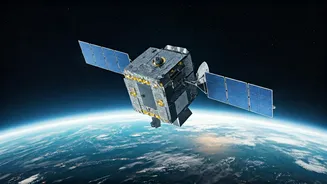

How Starlink Works
Starlink, a groundbreaking initiative, aims to provide high-speed internet access globally through a vast network of interconnected satellites orbiting
Earth. These satellites operate in low Earth orbit, enabling lower latency and faster data transmission compared to traditional geostationary satellites. Each satellite is equipped with advanced technology to communicate with ground stations and other satellites, forming a mesh network. When a user on the ground requests data, the signal travels from their terminal to the nearest satellite, which then routes it through the constellation to a gateway station connected to the internet backbone. This process is remarkably efficient, allowing for internet speeds that rival or even surpass terrestrial broadband services in many areas. The sheer number of satellites, designed to be relatively small and mass-produced, is a key factor in achieving widespread coverage. Furthermore, these satellites are designed with their own propulsion systems, allowing for orbital adjustments and eventual deorbiting at the end of their operational life, a critical aspect of space sustainability.
The Growing Constellation
The Starlink constellation is experiencing rapid expansion, with frequent launches adding more satellites to its orbital network. Recent successful launches, such as those carrying 28, 27, and 21 satellites, demonstrate the ongoing commitment to bolstering this ambitious project. The development of advanced manufacturing processes, capable of producing an astounding 15,000 Starlink internet kits daily, underscores the scale of this undertaking. This continuous growth aims to enhance coverage, improve reliability, and prepare for future advancements, including the integration of next-generation satellites like the V2 Starlinks. The goal is to create a robust and pervasive internet infrastructure accessible from virtually anywhere on the planet, bridging the digital divide in underserved regions. The sheer volume of satellites in orbit is a testament to the project's scale and its potential to reshape global connectivity.
Impact on Astronomy
The proliferation of Starlink satellites has raised significant concerns within the astronomical community. Their bright trails, particularly noticeable during twilight hours, can interfere with sensitive telescope observations, making it challenging to capture clear images of faint celestial objects. Scientists are actively researching methods to mitigate these effects, including developing new observation techniques and collaborating with the satellite operators to minimize reflectivity. The potential for satellite collisions is another area of concern, although extensive efforts are made to manage orbital paths and avoid such incidents. The rapid growth of satellite constellations necessitates ongoing dialogue and technological solutions to ensure that the pursuit of global connectivity does not come at the expense of scientific discovery and our ability to study the universe.
Broader Implications
Beyond communication and astronomy, Starlink satellites are revealing previously unseen details about our planet. Their vantage point from orbit has allowed scientists to identify 28 U.S. cities, including major metropolises like New York City and Chicago, that are experiencing sinking. This phenomenon, where the ground level is slowly decreasing, can have profound implications for infrastructure stability and flood risk. The ability to monitor such subtle changes from space highlights the transformative power of satellite technology. Furthermore, the deployment of satellite constellations like Starlink, alongside emerging efforts such as Amazon's Project Kuiper, signifies a burgeoning era of private enterprise in space, focused on delivering essential services and expanding humanity's reach beyond Earth.