





Orbitz: Gelatinous Globules
Orbitz, launched by The Clearly Canadian Beverage Corporation, was a beverage that truly defied convention. This non-carbonated drink distinguished itself
by suspending small gel spheres within its fruity liquid, creating a visually striking effect reminiscent of a lava lamp. Despite its novelty, the drink's market presence was fleeting, lasting only two years. Today, unopened bottles have become collector's items, commanding prices upwards of $900 for a dozen, a testament to its cult status among those who recall its peculiar charm. The unique texture and appearance made it a memorable, albeit short-lived, footnote in '90s beverage history.
Surge: Citrus Power Surge
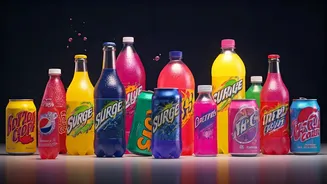
Introduced in 1997, Surge positioned itself as a formidable rival to Mountain Dew, boldly advertising itself as a 'Fully Loaded Citrus Soda with Carbos.' Its striking green and red branding and intense citrus flavor made an immediate impact, quickly gaining a reputation for its potent energy-boosting effects, particularly among younger consumers. This very intensity may have contributed to its eventual removal from school cafeterias. Discontinuation in 2003 sparked significant fan outcry, with social media campaigns and even a billboard near Coca-Cola's headquarters demanding its return. Though largely absent, limited runs of Surge-flavored slushies appeared at convenience stores and fast-food chains in 2014, and it has reappeared sporadically on Amazon and in small batches, catering to those who fondly remember its "disgusting" yet undeniably cool taste.
Slice: Fruit Juice Pioneer
Emerging in 1984, Slice initially aimed to challenge established soft drinks like 7 Up and Sprite by incorporating 10% fruit juice, a significant departure for the soda market at the time, leading to considerable early success. However, by 1990, the brand shifted its focus away from fruit juice content, relying instead on artificial flavors. The line largely disappeared by 2000, with its lemon-lime variant being rebranded as Sierra Mist. While various iterations of Slice reappeared in the 2000s, a 2024 relaunch introduced a revitalized version that touts pre-, pro-, and postbiotics, avoidance of high fructose corn syrup, and, once again, an unspecified amount of real fruit juice, signaling a return to its fruit-forward roots.
Snapple Elements: Ethereal Flavors
Snapple Elements, introduced in 1999, offered a mystical twist on the classic Snapple beverage. These drinks featured imaginative names like Rain, Earth, Air, and Fire, each housing uniquely inspired flavors. Rain, for instance, incorporated agave cactus, while Fire drew from dragonfruit. Over time, the line expanded to include 15 distinct varieties, such as Turbulence (shredded lemon) and Volcano (indigo grape). The discontinuation in 2005 coincided with challenges faced by Snapple, partly due to revelations about high fructose corn syrup content in its products, contradicting its 'all-natural' claims. In 2022, a revival of the Elements line met with mixed reactions, as many fans found the revived flavors didn't quite match their cherished childhood memories, highlighting the difficulty of perfectly recapturing a taste of the past.
Squeezit: Fun and Fruity
Squeezit drinks were a hallmark of '90s childhood, characterized by their distinctive hourglass-shaped bottles filled with brightly colored, fruit-flavored liquids. Designed for maximum kid appeal, they often featured popular cartoon characters, such as those from _The Teenage Mutant Ninja Turtles_, making them a fun lunchtime treat. The product eventually ceased production in the 2000s, possibly due to declining sales or perhaps as a response to concerns about the high sugar content inherent in these playful beverages. Their unique packaging and association with beloved characters made them a memorable part of many childhoods.
OK Soda: Anti-Marketing Statement
OK Soda, launched in 1994, embarked on an unconventional path by specifically targeting Generation X with an anti-corporate and anti-marketing ethos. Its branding was intentionally subdued, and drinkers were encouraged to call a special number to hear cryptic and unusual messages, further emphasizing its distinct approach. Paradoxically, the brand's strategy, which aimed to resonate with an anti-establishment youth demographic, may not have fully grasped the nuances of its audience, as the campaign reportedly failed to connect as intended. Consequently, the soda was discontinued in 1997, marking a brief but intriguing experiment in beverage marketing that attempted to subvert traditional advertising norms.
Josta: The Precursor Energy Drink
Josta, released in 1995, holds the distinction of being the first energy drink introduced by a major U.S. beverage company, predating the massive energy drink craze. Its appeal lay in its formulation, which combined caffeine with guarana, a South American vine known for its potent energizing properties, even more so than coffee. Despite its innovative blend, Josta struggled to gain widespread traction and was discontinued in 1999. Nevertheless, it maintains a dedicated following, with enthusiasts actively campaigning for its revival and even attempting to recreate the drink at home, showcasing its ahead-of-its-time appeal.