
Unseen Cosmic Event
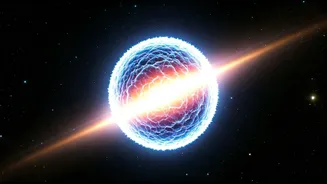
The discovery, made by the Hubble Telescope, centers around a shockwave in the vicinity of a dead star. What makes this particularly significant is the complete
novelty of the observation. Astronomers are now faced with a phenomenon that doesn't fit within current models, leading to extensive analysis. This unexpected finding has the potential to reshape established concepts about how stars evolve and interact with their surroundings at the end of their lifecycle. The team is now investigating the nature of this shockwave, seeking to understand its origin and its long-term impact on the surrounding cosmic environment. This represents a rare opportunity to study a unique astrophysical event that could provide clues to the universe's ultimate mysteries.
Hubble's Crucial Role
The Hubble Telescope, renowned for its exceptional observational capabilities, played a crucial role in capturing this remarkable event. It was able to observe and identify the shockwave. The telescope's instruments are finely tuned to detect the subtleties of celestial bodies, enabling the recording of the minute details. The data provided by Hubble enables astronomers to explore the nature of the shockwave, gathering essential data that would be otherwise inaccessible. Hubble's ability to peer into the deepest regions of space reveals new insights into the evolution of stars and galaxies. Without Hubble, this groundbreaking discovery might have remained elusive. Its continuous observation of the cosmos is critical to our scientific understanding.
Challenging Existing Models
The unprecedented nature of the shockwave presents significant challenges to the existing astronomical models. Theoretical frameworks often explain stellar events with a particular set of processes. However, this observation is indicating that there may be previously unknown forces at work. The shockwave doesn’t match the predictable patterns. Astronomers must re-evaluate their assumptions about how dead stars behave and how they interact with interstellar matter. This has prompted renewed interest in how energy is released and propagated during a star's final stages. This discovery will necessitate more research, including the development of new models to explain how such a phenomenon occurs. It also opens avenues for exploration into the unseen elements that compose the universe.
Future Research Directions
Moving forward, the focus will be on further exploration to explain this event and its cosmic implications. The next steps will likely include detailed observation. Researchers will use various techniques, including multi-wavelength analysis, to gain a deeper comprehension of the shockwave. This data analysis will focus on refining the theoretical frameworks to include new information. Additionally, the discovery might motivate new research into how stars of a similar mass evolve. Scientists are determined to understand the origin, the composition, and the consequences of this cosmic anomaly. This will require collaboration across institutions and the integration of multiple data sources. The discovery of the shockwave near the dead star stands as an opportunity to change our understanding of the universe.