






Core Strength Essentials
When it comes to building a resilient core that supports everyday movements and athletic endeavors, plank variations stand out as essential tools. The
bear plank, in particular, is a highly effective bodyweight exercise focused on fortifying the muscles responsible for spinal stability. Its beauty lies in its accessibility; no equipment is needed, though a yoga mat can enhance comfort. While generally safe, consulting a healthcare provider before starting any new exercise regimen is always recommended. This comprehensive guide delves into the fundamentals of the bear plank, including the specific muscle groups it engages, the correct execution technique, and a range of modifications to scale the difficulty up or down, alongside its scientifically validated advantages.
Targeted Muscle Engagement
Your core is more than just the visible 'six-pack' muscles; it encompasses deep abdominal muscles and spinal stabilizers that are crucial for maintaining an upright posture and preventing unwanted spinal movement during daily activities and sports. The bear plank effectively targets key muscles like the external and internal obliques, located on the sides of your torso, connecting your hips and ribs. It also engages the transverse abdominis, a deep, horizontal muscle layer situated beneath the obliques and rectus abdominis. Research consistently demonstrates that strengthening these core stabilizers through exercises like the bear plank can significantly alleviate lower back pain, reduce the risk of injuries, and enhance overall athletic capabilities. This holistic approach to core training offers practical benefits that extend far beyond aesthetics.
Mastering the Bear Plank
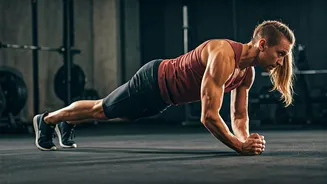
The bear plank serves as a foundational exercise within a broader spectrum of core strengthening movements, offering both regressions (easier variations) and progressions (harder variations). This makes it adaptable for individuals across different fitness levels. For those with some training experience and no current injuries, the standard bear plank is an excellent starting point. To perform it, begin on your hands and knees, flexing your feet and placing your toes on the ground. Actively press into the floor to engage your shoulder and chest muscles, ensuring your weight is evenly distributed through your hands. Tuck your tailbone slightly by engaging your glutes and contract your abdominals by bracing as if expecting a punch, drawing your navel towards your spine. Lift your knees approximately 1 inch off the ground, maintaining a neutral head position with your gaze directed downwards. Hold this position for at least 20 seconds, aiming to progress to 3 sets of 60 seconds. Incorporate this routine 2-3 times per week for optimal results.
Enhanced Core Stability
A significant advantage of practicing bear plank variations is the superior activation of the deep core stabilizers, namely the transverse abdominis and obliques. These muscles, alongside the rectus abdominis, are vital for protecting your spine and bolstering the stability of your lower back. Unlike traditional exercises such as crunches, which may not engage these crucial deeper muscles as effectively, bear planks provide more functional strength. Furthermore, some individuals find that exercises like situps can exacerbate existing lower back pain, whereas planking variations are designed to mitigate this. Scientific studies also indicate that consistent engagement in core exercises like planks directly correlates with improved performance in dynamic field sports, where agility and resistance are key, and a reduced likelihood of incurring injuries during such activities.
Variations for All Levels
For those finding the standard bear plank challenging, the quadruped abdominal brace offers a more accessible entry point, building foundational strength. In this variation, your knees remain on the ground while you focus on engaging your core and glutes. Simply follow the standard bear plank setup, but keep your knees down as you perform the core contraction for the same duration. Once you can comfortably hold the standard bear plank for 3 sets of 60 seconds, you can progress to the bear plank leg lift. This involves maintaining the bear plank position while slowly lifting one foot about 1 inch off the ground for a second, alternating sides. Aim for 10-20 leg lifts per set for 3 sets. For a more dynamic challenge, the bear crawl involves moving forward while in the floating-knee position, alternating arm and leg movements to simulate crawling. Finally, the advanced bear plank kick-through requires rotating your torso as you weave one leg under your torso and kick it out, raising the opposite arm. This variation demands significant core rotation and stability and is best performed after mastering the leg lift.