






Beyond Fixed Towers
Traditional mobile networks heavily depend on static towers, a model that frequently falters under sudden surges in user demand or unforeseen disruptions
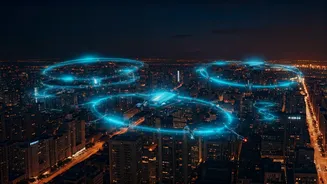
to infrastructure. Addressing this limitation, a pioneering research initiative from Stevens Institute of Technology is exploring a novel solution: employing a swarm of interconnected drones to serve as adaptable, temporary cell towers. This approach doesn't aim to replace existing ground infrastructure but rather to complement it, creating a flexible aerial layer capable of real-time adjustments to evolving network conditions. This dynamic capability is particularly crucial in densely populated urban areas where expanding physical tower capacity is challenging. The system is designed to appear precisely when and where it's needed, offering a stark contrast to permanently installed solutions.
AURA-GreeN's Smart Network
The innovative system, christened AURA-GreeN, fundamentally redefines the concept of a cell tower by utilizing multiple drones that function as mobile radio units. These aerial nodes are not static but actively communicate with each other and directly with users, dynamically altering their positions and operational roles in response to the prevailing network environment. This self-optimizing behavior allows the system to manifest coverage precisely when and where it is required. Professor Ying Wang from Stevens' Department of Systems Engineering highlights the particular benefit for bustling cities, especially during critical events like traffic management operations, disaster response, or search-and-rescue missions, where rapid and dependable wireless communication is paramount. The system meticulously monitors signal quality, potential interference, and overall traffic volume, intelligently dictating data routing and spectrum allocation to maintain stable connections even amidst congestion or partial network outages.
Freshness of Information
AURA-GreeN extends its functionality beyond simply ensuring continuous connectivity by focusing on the efficiency with which information traverses the network. The researchers introduce a novel performance metric known as the 'age of information,' which quantifies how current and relevant transmitted data remains. This metric is especially critical in time-sensitive scenarios. PhD candidate Ishan Aryendu explains that the system actively works to minimize this 'age of information,' guaranteeing users access to exceptionally fresh data that closely mirrors real-time events. Studies have demonstrated a remarkable 460% improvement in the age of information using this methodology. Concurrently, the system adeptly juggles multiple operational priorities, including minimizing data delays, optimizing spectrum usage, preserving connection stability, and managing energy consumption within defined limits. However, this multi-faceted optimization presents inherent challenges, as advancements in one area can potentially strain resources in another.
Real-World Potential
While laboratory tests for AURA-GreeN have yielded highly encouraging outcomes, the practical realities of real-world deployment might introduce complexities not fully captured in controlled settings. Beyond its critical role in emergency situations, the system holds significant promise for supporting large-scale public gatherings where conventional networks often buckle under sudden, immense demand. The researchers also note a synergistic application where drones already employed for event coverage, such as filming, could simultaneously provide essential network coverage. This 'piggybacking' approach leverages existing drone deployments, thereby enhancing their utility and expanding coverage without requiring dedicated infrastructure. The ability to dynamically adapt and provide reliable, up-to-date connectivity underscores the transformative potential of this drone-based network solution.