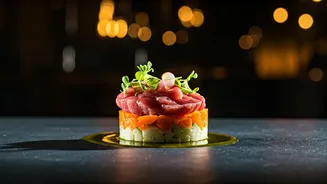







From Tyres to Tables
The iconic Michelin star, now a symbol of culinary prestige, began its journey in the early 20th century as a practical tool for motorists. Brothers André
and Édouard Michelin, founders of the tire company, initially launched their guide in 1900, filled with practical advice for drivers, including maps and maintenance tips, all with the strategic aim of encouraging road travel and thus, boosting tire sales. It wasn't until 1920 that the guide took a significant turn, being reissued with restaurant recommendations specifically for France. This pivot marked the beginning of the guide's evolution into a culinary arbiter, laying the groundwork for the prestigious star system that would soon follow and forever change the landscape of fine dining.
The Birth of the Star
The concept of awarding stars to restaurants took shape in 1926 when Michelin introduced its first star system, recognizing 46 establishments in France for their exceptional cuisine. This system underwent a crucial refinement in 1931, expanding to a three-tier rating. The criteria, formally published five years later, established a benchmark that remains remarkably consistent today: one star signifies 'a very good restaurant in its category,' two stars indicate 'excellent cooking, worth a detour,' and three stars denote 'exceptional cuisine, worth a special journey.' This consistent framework has provided a clear and aspirational goal for chefs worldwide, contributing to the enduring prestige associated with achieving these coveted accolades.
Expanding Horizons
Beyond the core star ratings, Michelin has continuously adapted its commendations to reflect broader culinary values. In 1997, the Bib Gourmand was introduced, highlighting restaurants that offer high-quality food at an accessible price point. Later, the 'Selected Restaurants' designation (formerly the Michelin Plate) was created to acknowledge establishments serving commendable cuisine without necessarily meeting star criteria. More recently, in 2020, the Michelin Green Star emerged, specifically celebrating restaurants demonstrating a strong commitment to sustainable gastronomy. These additions showcase Michelin's commitment to recognizing diverse aspects of culinary excellence across an ever-widening global scope.
Pioneering Establishments
The history of Michelin stars is dotted with remarkable establishments that have pushed boundaries and set records. Georges Blanc restaurant in Vonnas, France, holds a place of honor as one of the longest-standing recipients, continuously holding at least one star since 1929. In contrast, the title of cheapest Michelin-starred establishment is hotly contested, with Mexico City's taqueria El Califa de León offering tacos for a mere 58 MXN (£2.45), a testament to accessible excellence. On the pinnacle of sustained achievement, the late Paul Bocuse's restaurant near Lyon maintained three stars for an unparalleled 55 consecutive years, from 1965 to 2020, solidifying his legacy as a titan of French gastronomy. These diverse examples illustrate the wide spectrum of culinary brilliance recognized by the guide.
Records and Rebirths
The journey to a Michelin star isn't always linear, as evidenced by some extraordinary cases. Shanghai's nuò, for instance, experienced the shortest-lived star, closing its doors a day after receiving its first in 2016 due to licensing issues, only to be reborn in a new location and eventually earn three stars and a Green Star. On the other end of the spectrum, London's Behind achieved its star with remarkable speed, having been open for just 20 days in 2021, showcasing rapid culinary prowess. Furthermore, the pioneering spirit of vegan cuisine was recognized when Frankfurt's Seven Swans was awarded a star in 2020, becoming the first exclusively vegan restaurant to receive this honor, demonstrating the expanding definition of gastronomic excellence.