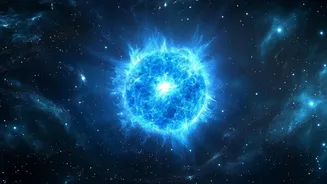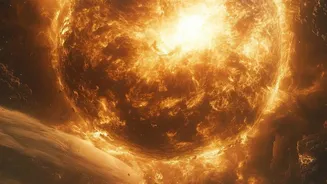



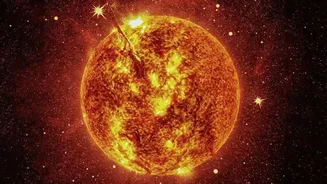
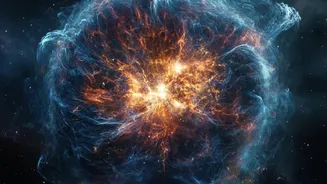
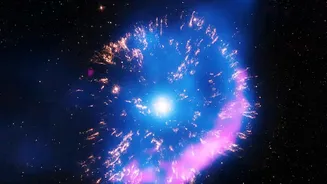
When a massive star dies, it’s supposed to go out with a bang—a spectacular supernova. But sometimes, these giants just vanish. A new study suggests a culprit for this cosmic mystery: the strange behaviour of tiny, 'ghostly' neutrinos.
The Cosmic Disappearing Act
The universe is
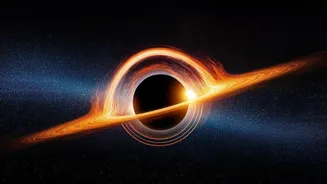
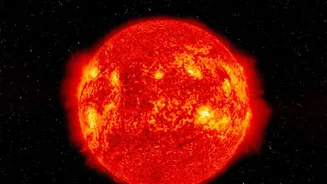
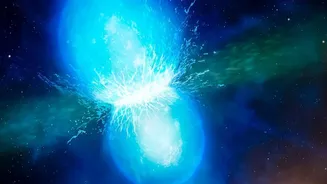
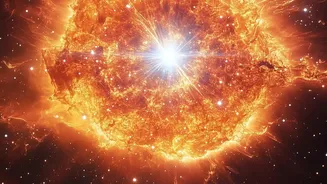
filled with dramatic events, but few are as powerful as a supernova. When a star at least eight times the mass of our sun runs out of fuel, its core collapses under its own immense gravity. This collapse triggers a violent explosion that can outshine an entire galaxy, scattering heavy elements essential for life across the cosmos. For decades, this was the accepted life story for most massive stars. However, astronomers have been puzzled by what they call the 'supernova rate problem'—they observe far fewer of these explosions than their theories predict. Adding to the mystery are observations of giant stars that seem to simply wink out of existence, disappearing from the night sky without the expected fanfare. This phenomenon, dubbed a 'failed supernova' or 'unnova', suggests that some stars don't explode at all; they just collapse, leaving a black hole in their place.
Enter the 'Ghost Particle'
To solve this puzzle, scientists are looking at one of the universe's most elusive and strangest particles: the neutrino. Often called 'ghost particles', neutrinos are almost massless and have no electric charge, meaning they barely interact with other matter. Trillions pass through your body every second without you ever noticing. But during the core collapse of a star, they are produced in almost unimaginable numbers, carrying away about 99% of the event's colossal energy. In a typical supernova, a fraction of these escaping neutrinos slams into the material just outside the core, heating it up and powering the outward explosion. Without this neutrino-driven push, the explosion would stall, and the star would fail to detonate. The fate of a star, it turns out, hinges on the actions of these tiny ghosts.
A Symphony of 195 Collapses
A recent study by researchers at the University of Copenhagen has shed new light on this process. Simulating the death of a massive star is incredibly complex and computationally expensive. The team ran an unprecedented 195 simulations, modelling the core collapse of stars ranging from nine to 120 times the mass of our sun. The critical new element they included was a phenomenon called 'neutrino flavour conversion'. Neutrinos come in three types, or 'flavours'—electron, muon, and tau—and they can switch between these types as they travel. Previously, it was thought these flavour changes were a minor detail in a supernova. This new study systematically tested what would happen if this flavour-swapping was included in the models, revealing it to be a game-changer.
How Neutrinos Can Veto an Explosion
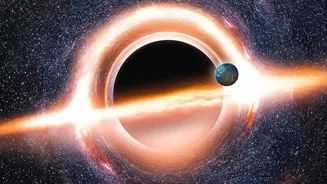
The simulations delivered a clear and surprising pattern. For a significant number of stars, particularly those between 16 and 30 times the sun's mass, including neutrino flavour conversion flipped the outcome entirely. Stars that were predicted to explode as supernovae in standard models instead failed and collapsed directly into black holes. The mechanism is subtle but powerful. The different neutrino 'flavours' interact with matter differently. By changing flavour at a critical moment inside the dense, collapsing core, the neutrinos can alter the energy flow. This can reduce the heating of the material surrounding the core, robbing the shockwave of the power it needs to blast the star apart. Instead of a spectacular rebound, gravity wins the tug-of-war, and the entire star implodes into a black hole with no visible explosion.
Solving One Puzzle, Finding New Clues
This discovery provides a compelling explanation for the missing supernovae that have long puzzled astronomers. If a significant fraction of massive stars collapse quietly into black holes, it would naturally explain why we see fewer explosions than expected. It also accounts for the observed disappearances of some red supergiant stars. Furthermore, the study found that even when stars do explode, this neutrino behaviour could lead to the formation of lower-mass neutron stars, another finding that aligns better with recent astronomical observations. While this research marks a major leap forward, it also highlights how much is still unknown. Future work will involve incorporating these complex neutrino physics into even more detailed 3D simulations to refine our understanding of how the universe's most massive stars live and die.