

A Trial Through Treacherous Terrain
South Western Railway has initiated a critical trial for a Vande Bharat Express on the proposed Bengaluru-Mangaluru route. The focus of this test, running from August 11 to August 20, is the Sakleshpur-Subrahmanya Road ghat section. This 55-kilometre
stretch through the Western Ghats is considered one of the most technically demanding railway sections in the entire country. Engineers from the Research Designs and Standards Organisation (RDSO) are closely monitoring the train's performance, as its success is a key step toward launching a regular passenger service connecting Karnataka's capital with its major coastal city.
The Challenge of 108 Sharp Curves
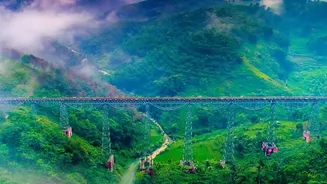
The primary reason for this intense scrutiny is the route's difficult geography. The 55-km ghat section features not only steep gradients but also 57 tunnels, 226 bridges, and, most significantly, 108 sharp curves. High-speed trains like the Vande Bharat are designed for straight, modern tracks where they can reach speeds of 160 kmph or more. Sharp curves, a legacy of older railway lines built through challenging landscapes, force trains to slow down dramatically to ensure safety and passenger comfort. On this specific stretch, the maximum permitted speed is just 30 kmph, a severe bottleneck that negates the Vande Bharat's primary advantage of speed.
Special Modifications for a Special Route
This is no ordinary Vande Bharat. To tackle the steep slopes and sharp bends, a specially modified 20-coach rake has been deployed for the trial. The most crucial addition is an Automatic Emergency Braking (AEB) system. This safety feature is mandatory for the ghat section and is designed to automatically apply the brakes if the train exceeds the 30 kmph speed limit on downhill stretches. Conventional trains often use extra engines, known as banker locomotives, to navigate such steep terrain. However, the integrated, self-propelled design of the Vande Bharat makes this approach impractical. The built-in AEB system is Indian Railways' answer to operating this modern trainset safely on a vintage, challenging line.
Beyond Curves: The Promise of Tilting Trains
While the current trial focuses on braking and safety at low speeds, the problem of curves is a nationwide challenge for the Vande Bharat network. To address this, Indian Railways is investing in 'tilting train' technology. A tilting train has a special mechanism that allows the coaches to lean into curves, much like a motorcyclist does. This counteracts the centrifugal force that passengers feel, allowing the train to maintain higher speeds through bends without compromising comfort. The plan is to manufacture 100 Vande Bharat trains with this technology by 2026, which could significantly cut travel times on existing tracks that are full of curves. A successful trial here could pave the way for broader adoption of advanced solutions.
What Success Means for Passengers
If the Vande Bharat successfully passes these safety trials, it will be a major milestone. For one, it would bring the launch of the much-awaited Bengaluru-Mangaluru service one step closer, promising a faster, more comfortable, and incredibly scenic journey through the Western Ghats. More broadly, it represents a significant engineering achievement for Indian Railways. Proving that a modified Vande Bharat can safely operate on one of the nation's toughest routes demonstrates a new level of technical capability. It suggests that with the right modifications and, eventually, technologies like tilting, the benefits of semi-high-speed rail can be extended to many more parts of the country, even those with older, more challenging infrastructure.