




Born From Collision, Built For Instability
The story of the Himalayas’ danger begins with their birth. These are geologically young mountains, formed by the ongoing collision of the Indian and Eurasian tectonic plates. This constant grinding and pushing makes the region seismically active, with earthquakes
being a persistent threat. Unlike older, more settled mountain ranges, the Himalayas are still rising, resulting in some of the steepest and most unstable slopes on Earth. This fundamental geological instability is the primary reason the ground itself is prone to sudden, violent movements, setting the stage for other hazards.
One Event, A Cascade of Crises
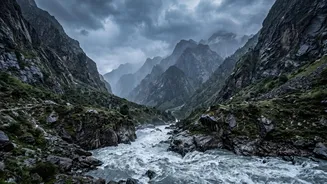
The true danger in the Himalayas lies in what scientists call "cascading hazards"—a domino effect where one disaster triggers another. An earthquake, for instance, doesn't just shake the ground. It can dislodge massive sections of a mountainside, causing a devastating landslide. This landslide can then crash into a river, forming a temporary dam made of rock and debris. As water builds up behind this unstable barrier, the pressure mounts until the dam bursts, releasing a ferocious flash flood or a thick, fast-moving debris flow downstream that can travel for hundreds of kilometres, destroying everything in its path. This is how a single event high in the mountains can evolve into a multi-part catastrophe affecting communities far below.
A Warming World's Dangerous Accelerator
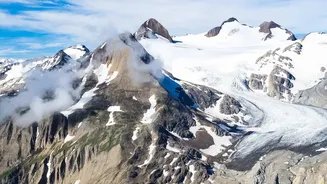
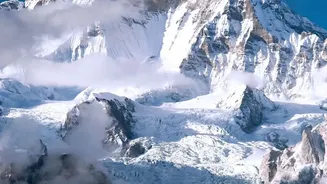
Climate change is acting as a powerful accelerator for these disaster chains. The Himalayas are often called the “Third Pole” because they hold the largest concentration of ice outside the polar regions. As global temperatures rise, these glaciers are melting at an alarming rate. This has two critical consequences. First, the permafrost that acts like glue holding rock and soil together on steep slopes is thawing, making landslides and rockfalls more likely. Second, the meltwater is forming vast, unstable lakes, known as Glacial Lake Outburst Floods (GLOFs). These lakes are often held back by nothing more than loose rock and soil. An avalanche, a landslide, or even just the pressure of the rising water can cause these natural dams to fail, unleashing a torrent of water with little to no warning.
The Human Fingerprint on Fragile Slopes
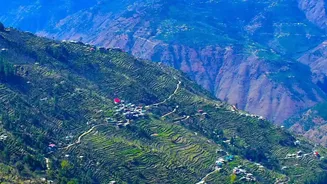
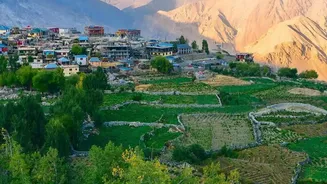
Natural forces lay the groundwork, but human activity often amplifies the risk. The construction of roads, dams, and buildings on steep, fragile slopes can destabilise the terrain, increasing the likelihood of landslides. Unplanned development often occurs in high-risk areas, like riverbeds or the base of vulnerable hillsides, putting more people directly in harm's way. Deforestation and improper excavation for infrastructure projects can weaken the soil's ability to hold together, especially during periods of intense rainfall, which are also becoming more frequent due to climate change. These activities not only increase the vulnerability of communities but can sometimes be the direct trigger for a disaster.
When The Chain Reaction Ignites
Recent tragedies in the region serve as stark reminders of how these factors combine. A disaster might begin with a massive chunk of a hanging glacier breaking off high in the mountains. The impact of millions of tonnes of ice and rock hitting the valley floor can generate its own seismic signal, equivalent to an earthquake. This collapse can trigger landslides that block a river. When the makeshift dam inevitably fails, a wall of water, mud, and boulders surges downstream, wiping out entire villages and critical infrastructure like bridges and power stations in minutes. These events highlight that what appears to be a sudden flood is often the final, tragic outcome of a complex chain reaction that started miles away and hours earlier.