





A Journey for the History Books
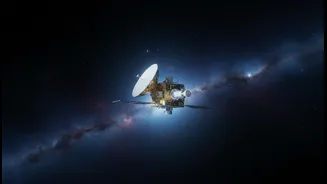
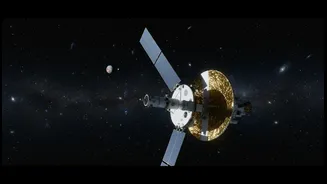
Launched in 2006, New Horizons is one of the most storied explorers of our time. It was the fastest spacecraft ever launched from Earth, embarking on a nine-year, three-billion-mile journey to its primary target. In July 2015, it made history, executing
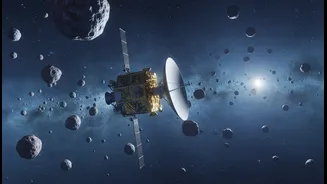
a flawless flyby of the dwarf planet Pluto. The data it sent back transformed our understanding of this distant world, revealing towering mountains of water ice, vast nitrogen glaciers, and a surprisingly complex, active surface on a world once considered a simple, frozen ball. But Pluto wasn't the end of the road. On New Year’s Day 2019, the probe made the most distant planetary encounter in history, flying past Arrokoth, a strange, snowman-shaped object in the Kuiper Belt. This visit provided an unprecedented look at one of the primitive building blocks of our solar system.
Where Is It Now?
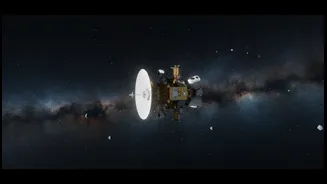
As of July 2026, New Horizons is speeding through the cold, dark expanse of the Kuiper Belt, the donut-shaped ring of icy bodies beyond Neptune. It is now approximately 9.5 billion kilometers (about 5.9 billion miles) from Earth. At this immense distance, radio signals traveling at the speed of light take nearly nine hours to travel between the spacecraft and mission control. After a long, 321-day hibernation to conserve resources, NASA confirmed in early July 2026 that the probe had woken up and was in good health. While it was 'sleeping', several of its instruments, including its plasma and dust detectors, continued to gather data about its unique environment, effectively making it a lonely scientific outpost in the far reaches of our solar system.
The Sun’s Final Frontier
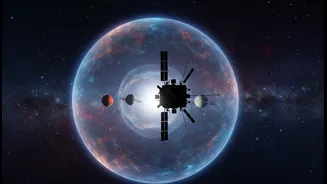
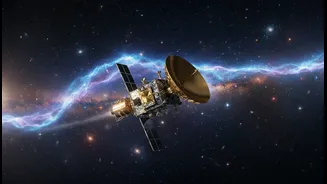
So where is it going? New Horizons is headed toward a boundary known as the heliopause. Think of the solar system as existing inside a giant, protective bubble called the heliosphere. This bubble is 'inflated' by the solar wind, a constant stream of charged particles flowing outward from the Sun. The heliopause is the edge of this bubble, where the outward push of the solar wind becomes too weak to push back against the 'wind' from other stars in the interstellar medium. It is, for all intents and purposes, the border between our solar system and the vast ocean of interstellar space. It's not a thin, static line, but a dynamic, fluctuating region that expands and contracts.
A New Perspective on an Old Boundary
Only two other active spacecraft, Voyager 1 and Voyager 2, have ever crossed this boundary, in 2012 and 2018 respectively. However, the New Horizons crossing will be special. It is equipped with more modern and sensitive instruments than its decades-older predecessors. Its plasma spectrometers, SWAP and PEPSSI, are designed to measure the solar wind and other charged particles with incredible precision. Furthermore, the Voyagers crossed the heliopause during a very active solar cycle, while New Horizons is traveling during a much milder one. This means it will provide a completely different data set, giving scientists a new perspective on how this interstellar border behaves under different solar conditions.
What Will It Find?
The primary goal is to study the heliosphere's boundary structures. New Horizons will first encounter the 'termination shock', where the solar wind dramatically slows down, before reaching the heliopause itself. Scientists have been creating predictive models to estimate when this will happen, with current forecasts placing the termination shock crossing somewhere between 2029 and 2040. The wide window is because the boundary itself is in flux. When it gets there, New Horizons will measure the changes in plasma, magnetic fields, and cosmic rays, offering invaluable data about the interaction between our Sun's domain and the galaxy beyond. These measurements will help us understand the very nature of our solar system's protective shield against harsh galactic radiation.