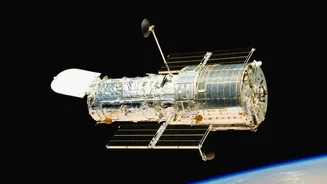





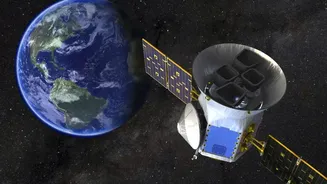

The skies above Earth are becoming dangerously crowded. To address this growing threat, the UK Space Agency is funding a pioneering mission, set for 2029, to capture and remove two defunct satellites, a crucial step towards cleaning up our orbital neighbourhood.
A Junkyard Above Our World
Low Earth Orbit, the vital region of space where thousands of satellites for communication, navigation, and weather forecasting operate, is increasingly cluttered with space debris. This 'junk' consists of everything from defunct satellites and spent rocket stages to tiny fragments from past collisions. These objects travel at incredible speeds, exceeding 17,000 miles per hour, meaning even a small piece of debris can cause catastrophic damage to an active satellite. Experts have long warned of a potential chain reaction known as the 'Kessler Syndrome', where collisions create more debris, which in turn leads to more collisions, potentially rendering parts of orbit unusable for generations. The European Space Agency now estimates there are over 130 million pieces of debris between 1 millimetre and 1 centimetre in size, making proactive cleanup essential.
The UK's Active Debris Removal Mission
In response, the UK Space Agency has commissioned the nation's first Active Debris Removal (ADR) mission. This ambitious project, planned for a 2029 launch from the SaxaVord Spaceport in Scotland, will be a world-first, aiming to capture and de-orbit two separate, defunct UK-registered satellites in a single mission. The Swiss company ClearSpace has been selected as the prime contractor to deliver the mission, backed by a contract worth over £61 million. The goal is to demonstrate the UK's capability in rendezvous and proximity operations, and to establish flight heritage for the complex technologies needed to safely approach and handle 'unprepared' objects that were not designed to be captured or serviced.
How the 'Space Claw' Works
The mission will utilise a highly advanced servicing spacecraft equipped with a robotic capture system, sometimes described as a giant 'space claw'. This system, which may feature multiple arms, is designed to carefully grab onto the target satellites. A significant challenge is that these target satellites are 'uncooperative', meaning they cannot assist in the process and may be tumbling uncontrollably. The servicer must autonomously navigate, approach, and secure the debris without causing further fragmentation. Once a satellite is captured, the servicer will drag it into a lower orbit, causing it to re-enter Earth's atmosphere where it will safely burn up. The UK ADR spacecraft is also being designed to be refuellable, with the potential for it to 'sweep space' on future missions.
Pioneering a Sustainable Future in Space
This mission is about more than just tidying up. It represents a critical step in establishing a sustainable and responsible approach to space operations. By proving that active debris removal is a viable technology, the UK aims to pave the way for a commercial market in in-orbit services. These services could include not only debris removal but also satellite life extension, refuelling, and repairs, creating a circular economy in space. According to the UK's Space Minister, the mission is essential for protecting the satellite infrastructure that underpins modern life, from GPS and banking to national security. It sends a strong signal about the importance of clearing orbital pathways to ensure future access to space remains safe and secure for all nations.