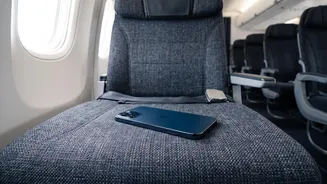






It’s a traveller’s mini-nightmare: you’ve just stepped off the plane and realise your phone, wallet, or headphones are still in the seat pocket. Your first instinct is to turn around, but you’re stopped. Why can't you just go back?
It Starts with Security
The number one reason
you cannot simply walk back onto an aircraft is security. Once you step off the plane and onto the jet bridge, you have officially exited a highly controlled, sterile environment. From a security perspective, allowing a passenger to re-enter would be a breach. Aviation security protocols are built on the principle of maintaining a secure zone. Once someone leaves that zone, their security status is reset. To get back on, they would theoretically need to be re-screened, which is an impossible process to manage during the organised chaos of deplaning.
The Immigration and Customs Barrier
For international flights, the rules are even stricter and involve national borders. When you deplane, you are proceeding toward the immigration and customs checkpoint to officially enter the country. Stepping back onto the aircraft would be akin to exiting the country you just arrived in, creating a significant bureaucratic issue for border control agents. This would require complex procedures, potentially involving passport exit and re-entry stamps, and would disrupt the official passenger manifest that authorities rely on. Even in cases of flight diversions, passengers are often processed by Customs and Border Protection (CBP) under special parole conditions before they can even move to a holding area.
Operational Precision and Passenger Counts
Airlines run on incredibly tight schedules, and passenger manifests are a critical part of that precision. Before any flight departs, the airline has a final, verified count of every soul on board. This manifest is crucial for calculating the aircraft's weight and balance, ensuring fuel loads are correct, and for safety and security records. A passenger wandering back on, even for a moment, can disrupt this count. If there's any discrepancy in the headcount, it can trigger a security check or a full passenger re-count, leading to significant delays for the next flight. The crew's focus immediately shifts from the arriving passengers to preparing for the next departure.
The Race to Turn the Aircraft Around
The moment the last passenger steps off, a timer starts for the ground crew. The process, known as 'turnaround', involves a flurry of coordinated activity. Cleaners move through the cabin to prepare it for the next set of travellers, catering services restock galleys, and ground staff perform necessary checks. This entire process is often completed in as little as 30 minutes. A passenger searching for a lost item would directly interfere with this tight schedule, causing a domino effect of delays that could impact multiple flights throughout the day. Going against the flow of deplaning passengers is also a safety hazard in the confined space of an aisle and jet bridge.
What to Do if You Forget Something
So, if you can't go back, what should you do? Act fast. The moment you realise you've left an item, find the nearest airline staff member at the gate. While you can't reboard, they can. A gate agent or a crew member can radio down to the cabin crew or cleaning staff who are still on the aircraft and ask them to retrieve your item. Give them your exact seat number and a clear description of what you lost. If the plane has already departed, your next step is to file a lost item report on the airline's website. Items found on planes are typically sent to the airline's lost and found office at that airport. While not a guarantee, many passengers are successfully reunited with their belongings through this process.