



A Galaxy Entering Middle Age
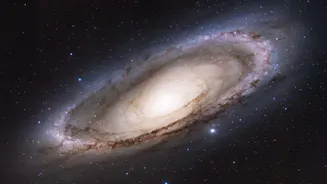
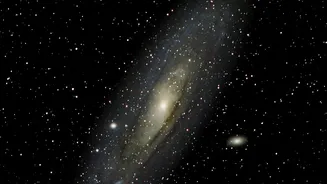
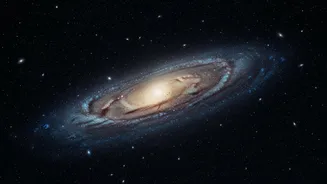
Our closest large galactic neighbor, Andromeda, is entering its cosmic middle age. A detailed new study using data from NASA's Hubble Space Telescope has found that the galaxy's production of new stars has been steadily falling for the last 500 million
years. Astronomers measure this activity by calculating how much gas and dust is converted into stars each year, a unit known as solar mass. About half a billion years ago, Andromeda was forming stars at a rate of roughly one solar mass per year. But by 40 million years ago, that rate had already dropped by half. Today, the output has plummeted even further, to about one-fifth of a solar mass annually. This slowdown suggests Andromeda is transitioning from a vibrant, active galaxy to a more quiescent state.
Reading the Fossil Record of Stars
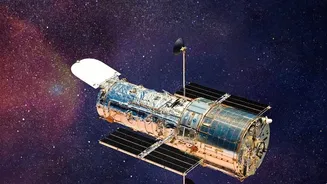
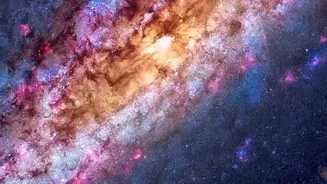
To uncover this history, astronomers acted like cosmic archaeologists. The discovery was made possible by combining data from two massive Hubble surveys: the Panchromatic Hubble Andromeda Treasury and the Panchromatic Hubble Andromeda Southern Treasury. Together, these projects mapped two-thirds of Andromeda's disk, measuring the properties of nearly 200 million individual stars. Stars serve as a 'fossil record' of a galaxy's past. Massive, young stars burn hot and appear blue, but they have short lifespans. Less massive, older stars are cooler, glow redder, and live much longer. By analysing the distribution of blue and red stars, scientists can create a timeline of star-forming activity. The team divided the galaxy into thousands of sections to build a comprehensive map of its evolutionary history, revealing where and when star birth has faded.
A Natural Winding Down
The decline doesn't appear to be caused by a lack of raw materials. Instead, it seems to be a natural winding down after a more energetic period. Previous research indicates Andromeda experienced a massive burst of star formation about two billion years ago, likely triggered by a merger or interaction with another, smaller galaxy. Much of the recent star-forming activity has been concentrated in a prominent ring about 32,000 light-years from the galactic center, and it is the fading of this ring that is driving much of the overall decline. Researchers have also pointed to Andromeda's small satellite galaxy, M32, as a potential suspect for some of the disruption. Data shows a drop in star formation in the area near M32, suggesting an interaction around 60 million years ago could have disturbed stellar nurseries.
A Glimpse into the Milky Way's Future
Because Andromeda is so similar to our own Milky Way, studying its life cycle offers a preview of what might lie ahead for us. Located just 2.5 million light-years away, it's the perfect laboratory for understanding how large spiral galaxies evolve and eventually run out of steam. Like Andromeda, our galaxy is destined to slow its star production as it ages. Observing this process next door provides valuable clues about our own long-term future. Furthermore, the two galaxies are on a collision course. While the exact timing is still debated by astronomers, current projections suggest they could merge in roughly 4 to 5 billion years, eventually forming a new, giant elliptical galaxy often nicknamed 'Milkomeda'. Understanding Andromeda's current state helps refine models of this monumental future event.